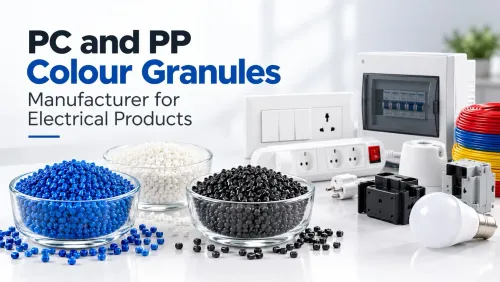
Appliance parts that look identical can behave very differently after moulding because resin family, colour system, filler content, moisture and wall thickness all affect performance. By the end, you will know how to choose between PC, PP, PC/ABS and other options, define a reproducible colour, and qualify a supplier before placing a production order.
Key takeaways
- Match PC, PP or PC/ABS to impact, heat, clarity and electrical requirements.
- Define colour using master samples, instrument readings and approved tolerance limits.
- Request MFI, ash, moisture, additive, batch and processing-temperature data before ordering.
- Audit supplier samples, batch traceability, testing records and replacement procedures.
Where PC and PP Colour Granules Fit in Appliance Manufacturing
PC colour granules suit appliance parts that need high impact strength, heat resistance or electrical insulation. Use them for vacuum-cleaner and mixer housings, control panels, switch surrounds, protective covers, transparent indicator windows and translucent light pipes.
PC retains toughness better than PP in drop-prone housings, but it costs more and needs controlled drying before injection moulding.
PP colour granules suit lighter, chemically resistant and lower-cost components. Washing-machine detergent drawers, inner tubs, storage bins, caps, handles, drain-related parts, refrigerator liners and moulded utility fittings commonly favour PP. Choose mineral-filled, talc-filled or unfilled PP deliberately: each changes shrinkage, stiffness, panel flatness and snap-fit engagement.
| Option | Better-suited appliance components | Main reason |
|---|---|---|
| PC | Impact-prone housings, control panels, indicator windows, electrical covers | Toughness, heat resistance and transparency |
| PP | Interiors, drawers, bins, caps, handles and utility parts | Low density, chemical resistance and economical moulding |
| PC/ABS | Decorative front housings and complex control bezels | Balance of appearance, flow and impact performance |
A colour match alone does not make a material suitable. Confirm that the colour plastic granules use a carrier compatible with the base polymer; PP-carrier masterbatch can reduce PC performance, while PC-compatible colourant is not automatically suitable for PP. Ask whether you are buying concentrated masterbatch for let-down or a ready-to-mould pre-coloured compound.
Evaluate the finished part at its actual thickness and texture. A colour that matches on a smooth test plaque can show different gloss, hiding power or weld-line visibility on a ribbed housing. For flame-rated electrical parts, verify the UL 94 V-0, V-1 or V-2 rating at the exact formulation and thickness.
How to Choose Between PC, PP, PC/ABS and Other Resins
Choose the resin by the part’s failure mode, not by colour. A lightweight PP housing is a poor choice if it must survive a hot, repeated impact; PC is wasteful where chemical resistance, low density and low cost matter more.
| Option | Performance advantage | Trade-off |
|---|---|---|
| PC | High impact strength, stiffness, heat resistance and transparent or translucent appearance | Higher density and cost; stress cracking can occur with incompatible cleaners |
| PP | Low density, chemical resistance, fatigue strength and economical moulding | Lower stiffness and heat resistance; weaker dimensional stability |
| PC/ABS | Better flow and appearance than PC, with balanced impact performance | Lower heat capability than PC and possible property loss from incorrect blending |
| Other resins | ABS suits rigid opaque housings; PBT suits electrical heat resistance; TPE suits soft grips | Each brings different shrinkage, weldability, chemical resistance and processing limits |
Ask for the finished formulation’s UL 94 rating at the part’s actual thickness. “Flame-retardant” colour granules alone do not prove V-0, V-1 or V-2 performance.
Confirm whether you are buying pre-coloured compound or masterbatch. Masterbatch needs a compatible carrier resin and specified let-down ratio; a PP carrier can reduce PC dispersion and toughness.
Ask a pc and pp colour granules manufacturer for impact strength, melt flow and heat-deflection data after colouring. A pc granules supplier must also identify virgin, reprocessed or recycled PC, because odour, contamination, molecular-weight loss and colour variation require separate qualification.
Finally, specify black-colour requirements for laser marking, infrared welding, sensors, heat staking and surface temperature. A visual match can still disable the appliance’s assembly or user interface.
How to Specify an Appliance Colour That Repeats Across Batches
Approve a physical master plaque, instrumental colour values, viewing conditions and an allowed tolerance—not “appliance grey” or a sample judged under unspecified lighting. The specification must describe the finished moulded part, because colour plastic granules can look different across thicknesses, textures and gloss levels.
1. Define the target with CIELAB L*, a*, b* values measured against the approved plaque. Record the colour difference limit, such as the agreed Delta E tolerance, plus the instrument model, calibration method, observer angle and illuminant, such as D65 for daylight simulation or A for warm indoor light.
2. Approve a plaque moulded from the production resin at the actual wall thickness, injection conditions and surface finish. Check a thin rib, textured housing and high-gloss panel separately; a match on a flat plaque can hide poor hiding power, weld-line contrast or a gloss shift on the appliance.
3. Examine the part under controlled D65 lighting and under the locations where customers will see it. Compare adjacent components together, including PC, PP, PC/ABS, painted pieces and printed labels, because metamerism can make two parts match in one light and visibly diverge in another.
4. Record functional constraints beside the colour: laser marking, infrared welding, ultrasonic welding, heat staking, optical sensing and surface-temperature limits. Black pigment can reduce marking contrast, alter sensor response and increase heat absorption.
5. Confirm the colourant carrier and let-down ratio match the base polymer. Retain the approved plaque and a moulded batch sample for every colour approval.
What Technical Data to Request Before Ordering Granules
A moulding trial can fail even when the colour chip matches. Confirm whether you are buying pre-coloured compound, ready to mould at its stated properties, or masterbatch for let-down into natural resin; these products require different dosing and validation.
Request these details before approving an order:
- Base resin: PC or PP grade, virgin, reprocessed or recycled status, and any PC/ABS blend.
- Flow data: MFR test temperature and load, density, pellet form, ash or filler content, and batch-to-batch colour variation, preferably ΔE under a named illuminant.
- Processing window: melt and mould temperatures, injection speed, back pressure, residence-time limit, and drying temperature and time.
- Performance: notched Izod impact, tensile strength, HDT, shrinkage, UV resistance and flame rating.
- Compliance: UL 94 rating, RoHS and REACH declarations, plus food-contact or electrical approvals required for the component.
- Traceability: original compounder, lot number, production date, certificate of analysis and retained-sample policy. This matters when a “pc granules supplier” or “pp colour granules supplier in delhi” is not the compounder.
- Functional compatibility: confirm laser marking, infrared welding, ultrasonic welding, heat staking, coating adhesion or optical-sensor performance for the selected colour.
| Check | PC | PP |
|---|---|---|
| Moisture | Dry to the supplier’s stated cycle; wet pellets cause splay | Usually no drying when correctly stored; wet additives can still cause defects |
| Performance shift | Pigment loading can reduce flow or impact strength | Filler and colour loading can alter stiffness, shrinkage and flow |
| Colour function | Dark shades can affect marking and sensors | Dark shades can alter surface heating and optical response |
How to Qualify a PC and PP Colour Granules Supplier in Delhi
A colour chip that passes visual approval does not qualify a supplier. A PC and PP colour granules manufacturer for appliances in Delhi must prove that the coloured material retains the required impact, melt-flow, heat-deflection and traceability values after compounding.
| Supplier evidence | What to compare | Failure it prevents |
|---|---|---|
| Product identity | Masterbatch versus pre-coloured compound, carrier resin and let-down ratio | Wrong dosing, poor dispersion or incompatible resin |
| Material data | PC impact strength and heat-deflection; PP melt-flow, ash or filler content and processing range | A good-looking part that cracks, warps or moulds inconsistently |
| Batch control | Lot number, certificate of analysis, retained sample and original compounder | Untraceable material traded through several channels |
A PC and PP colour granules manufacturer should mould approval plaques at the actual part thickness and surface finish. Check a thin rib, textured housing and high-gloss panel for colour, gloss, hiding power and weld-line visibility; appearance changes with geometry.
Use this receiving checklist for every delivery:
- Match the pellet colour and form against the approved sample.
- Record lot number, manufacture date, seal condition and certificate of analysis.
- Test melt flow against the agreed range, then retain a sealed reference sample.
- Reject unexplained shifts in colour, odour, moisture or pellet size.
Ask a pp colour granules supplier in Delhi whether the material is virgin, reprocessed or recycled. For recycled PC, document contamination, odour, molecular-weight loss and colour history before blending it into a virgin specification. PLASTO INDIA AND POLYMERS can be compared on these same records, not on colour alone.
Frequently asked questions
Where do PC and PP colour granules fit in appliance manufacturing?
PC suits impact-resistant, heat-resistant, electrically insulating and transparent parts such as housings, covers, panels and light pipes. PP suits lightweight, chemical-resistant and living-hinge components where its lower density and processing behaviour fit the design.
How do you choose between PC, PP, PC/ABS and other resins?
Compare impact strength, heat exposure, stiffness, chemical contact, transparency, electrical performance, shrinkage and processing temperature. Choose PC for demanding impact and heat performance, PP for lightweight chemical-resistant parts, and PC/ABS when you need a balance of toughness, appearance and processability.
How can appliance makers specify a colour that repeats across batches?
Approve a physical master plaque and record colour measurements, lighting conditions, instrument geometry, gloss level and permitted tolerance. Keep the same resin grade, pigment system, surface finish, moulding conditions and approval process for every batch.
What technical data should you request before ordering colour granules?
Request the resin grade, melt flow rate, moisture limit, colourant type, additive package, ash or filler content, recommended drying and processing temperatures, batch number, test report and safety documentation.
How do you qualify a PC and PP colour granules supplier in Delhi?
Check production samples, colour repeatability, batch traceability, technical support, documentation, minimum order requirements, delivery consistency and how the supplier handles non-conforming material. Compare a PP colour granules supplier in Delhi or PC granules supplier using the same test parts and acceptance criteria.
Keywords