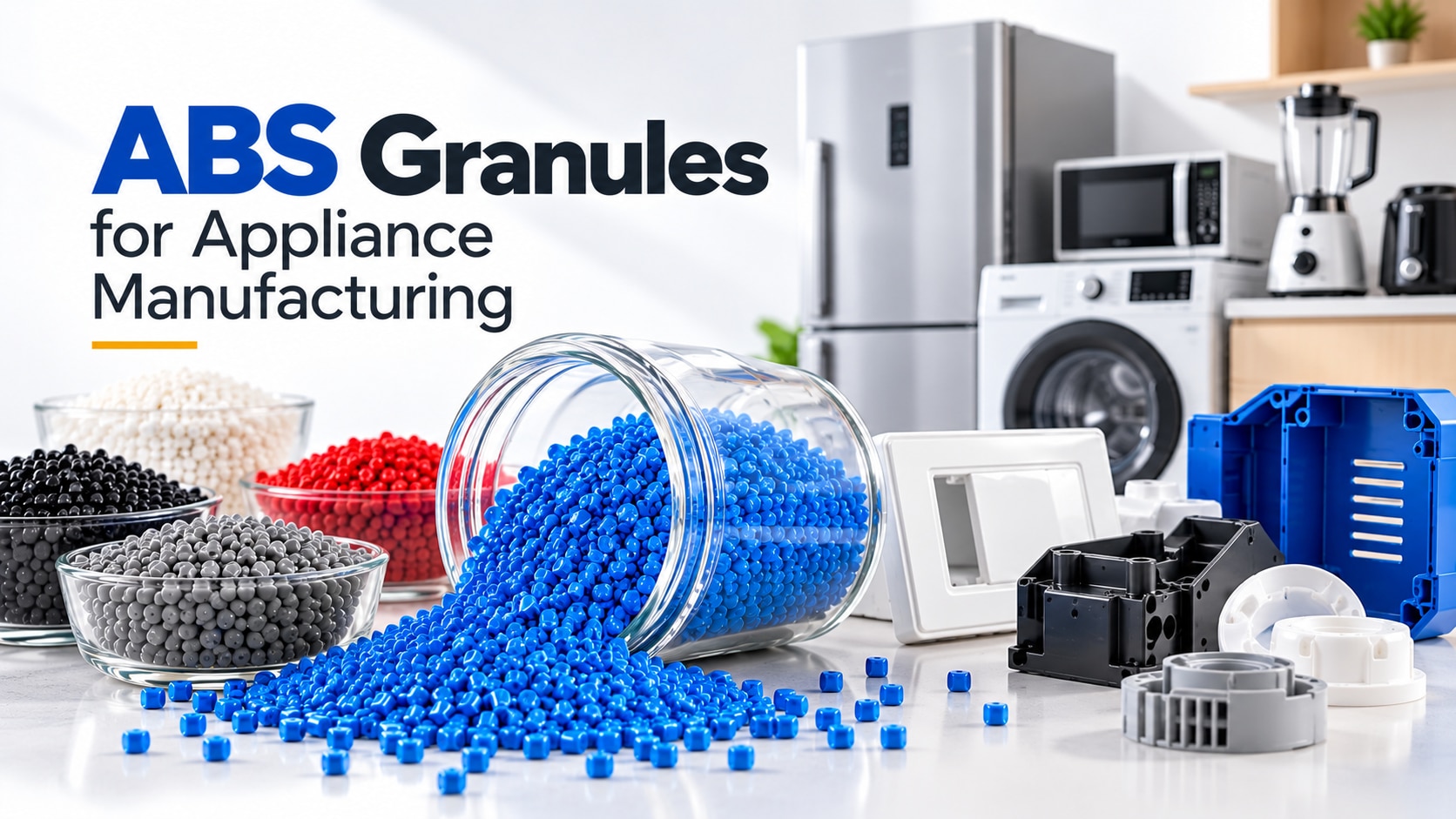
A blue pellet is not a complete material specification for an appliance part. You need to match the ABS grade to the component, moulding conditions, safety exposure and appearance standard, then verify that each delivered lot behaves like the approved sample.
Key takeaways
- Choose impact grade for housings and heat-stable grade for warm components.
- Confirm virgin, reprocessed or recycled content before approving an ABS lot.
- Request the TDS, SDS, COA and batch traceability documents from your supplier.
- Match blue colour using approved samples, colour measurements and lot-by-lot inspection.
Which Appliance Parts Use ABS, and Which Grade Fits Them?
ABS is common in refrigerator liners and door trim, washing-machine control panels, vacuum-cleaner housings, mixer-grinder bodies, fan components and small-appliance enclosures. The right grade depends on whether the part must look flawless, resist impact, support another component or meet a flame rating.
- Refrigerator liners and door components need consistent colour, gloss and impact performance across broad visible surfaces.
- Control panels and vacuum housings need a clean cosmetic finish, dimensional stability and reliable snap-fits.
- Mixer-grinder bodies, fan covers and small-appliance enclosures need impact strength; internal brackets can prioritise cost and stiffness.
- Parts near mains wiring require a separately documented flame-retardant grade, not ordinary ABS.
| Part location | Suitable ABS choice | Check before approval |
|---|---|---|
| Visible exterior | Virgin, colour-matched ABS with controlled melt-flow rate | Compare a retained blue reference plaque and inspect weld-line locations |
| Structural or snap-fit part | Impact-modified ABS with adequate stiffness | Test the actual gate, wall thickness and assembly force |
| Non-visible housing or bracket | Reprocessed or recycled ABS when permitted | Confirm material history, odour, contamination and regrind percentage |
| Electrical enclosure near wiring | ABS carrying a UL 94 V-0, V-1 or V-2 rating at the specified thickness | Do not transfer the rating between grades or thicknesses |
Blue ABS granules suit exterior parts only when the supplier controls lot shade and the mould produces acceptable gloss. Excessive shear or melt temperature can create colour shift, burning and moulded-in stress.
For appliance manufacturing granules, request the exact grade designation, MFR, impact and heat values, plus the processing window; “ABS dana” alone identifies none of these.
How ABS Granules Are Prepared and Moulded in Production
Clean filling, stable dimensions and a short cycle depend on matching the ABS grade to the production tool, not on the “ABS” label alone. Check melt-flow rate against the gate size, wall thickness, weld-line positions and cosmetic standard before releasing the material.
1. Confirm the exact grade, batch number and technical data sheet. An ABS dana supplier in Delhi may offer domestic, imported, recycled or repacked stock under the same trade term, so verify the manufacturer and grade code.
2. Dry opened or poorly stored pellets according to the grade data sheet. Controlled drying around 80 °C for several hours is a common practice; moulding wet ABS can cause splay, silver streaks, bubbles, dull surfaces and reduced impact strength.
3. Set barrel temperatures and screw speed inside the supplier’s processing window. Excessive melt temperature or shear can cause burning, colour shift, gloss variation and moulded-in stress, even when the part fills completely.
4. Set mould temperature for the required surface finish and dimensional control. A cold mould can freeze the flow front and exaggerate weld lines; a hotter mould can improve finish but lengthen cooling time.
5. Hold pressure until the gate freezes, then cool the part long enough to control shrinkage and warpage. Reducing cooling blindly may shorten the cycle while producing bowed panels, undersized clips or distorted housings.
Validate these settings in the actual tool using the intended blue resin. Factory-coloured pellets usually give more repeatable colour; blue masterbatch requires compatible carrier, correct let-down ratio and checks for changes in flow or mechanical properties.
Virgin, Reprocessed and Recycled ABS: What You Are Buying
Material history affects surface finish, impact strength, odour, colour consistency and contamination risk. “ABS dana” or “plastic dana” does not identify those properties, so ask the supplier for the exact grade code and material history.
| Option | What you are buying | Best fit and main risk |
|---|---|---|
| Virgin ABS | Consistent polymer with predictable colour, MFR and impact performance | Visible housings, bezels and control panels; highest material cost |
| Reprocessed ABS | Industrial scrap or approved production regrind processed again | Non-cosmetic housings and internal parts; heat history can reduce impact strength and change MFR |
| Recycled ABS | Post-industrial, post-consumer or blended recovered material | Cost-sensitive, non-visible parts; contamination, odour, shade variation and unstable processing need control |
| PC/ABS or HIPS | Alternative resin systems with different heat, impact and flow behaviour | PC/ABS for higher heat and impact; HIPS for lower-cost enclosures, after tool trials |
Do not approve “premium ABS” as a grade. Require the quotation to state virgin, post-industrial, post-consumer or blended content, plus the permitted regrind percentage, manufacturer, original grade code, batch number and sealed or repacked status.
Choose the grade for the part, not the lowest bag price:
- Use general-purpose or high-impact ABS for visible covers exposed to drops and handling.
- Use heat-resistant ABS near motors, heaters or warm internal zones; expect higher cost or reduced flow.
- Use flame-retardant ABS where the appliance specification demands a UL 94 rating.
- Use electroplating-grade ABS only after confirming the required surface and plating process.
Compare MFR, Izod impact, heat-deflection temperature, density, colour and lot-specific test results before running appliance manufacturing granules in the production mould. A high-flow grade can fill thin walls, but excessive shear can create burning, gloss variation and moulded-in stress.
Which Technical and Safety Documents Should a Supplier Provide?
Approve the grade only after the supplier provides a current technical data sheet and a lot-specific certificate of analysis. A brochure value does not prove that the delivered pellets meet the specification.
Request these records from the supplier:
- MFR or MFI, with ASTM D1238 or ISO 1133, test temperature and load stated. Values measured under different conditions are not directly comparable.
- Tensile or yield strength, Izod impact strength, heat-deflection temperature, density and colour information.
- The production lot number, manufacturing date, resin grade, virgin or reprocessed status, and certificate-of-analysis results for that lot.
- UL 94 evidence for parts near mains wiring or inside electrical enclosures. The document must state V-0, V-1 or V-2 and the tested thickness; a rating cannot transfer automatically to a thinner part.
- RoHS and REACH declarations naming the exact grade and revision date. RoHS covers restricted substances in electrical equipment, while REACH records substance communication and SVHC duties.
| Evidence | What to check | Approval consequence |
|---|---|---|
| Technical data sheet | Test standards, conditions, nominal values and processing window | Reject comparisons with missing temperature or load |
| Certificate of analysis | Lot number and actual MFR, density, colour and impact results | Hold a lot with no traceable results |
| Flammability report | Grade, thickness and UL 94 classification | Do not use standard ABS as flame-retardant material |
| Electrical declarations | Exact grade, revision date, RoHS and REACH scope | Escalate vague “compliant” statements |
Ask PLASTO INDIA AND POLYMERS, or any blue ABS granules supplier in Delhi, whether the pellets are pre-coloured or require masterbatch; record the carrier, let-down ratio and compatibility before approval.
Related products
 | ₹95 all colors ABS granules AVAILABLE CONTACT No. 9278699961 View product → |
 | # HIPS PLASTIC GRANULES MANUFACTURERS IN DELHI ₹112 Leading Manufacturer and Supplier of HIPS PLASTIC GRANULES in India . View product → |
How to Control Blue Colour and Inspect Every Delivered Lot
Approve blue colour against a retained master plaque, not against a photograph or loose pellets. Large appliance panels expose small lot-to-lot shifts, so every delivery needs lot traceability and a defined colour-control procedure from the blue ABS granules supplier.
1. Request the exact grade designation, lot number, production date, certificate of analysis and current technical data sheet. Check MFR, density, impact strength, heat-deflection temperature, colour and UL 94 status where applicable. “ABS dana” alone is not a grade.
2. Compare pellets and a moulded plaque with the retained reference under the same lighting. Record colour difference, gloss, opacity and surface finish; quarantine the lot if the shade, odour or pellet appearance changes without approval.
3. Confirm whether the material is factory-coloured or natural ABS with blue masterbatch. For masterbatch, verify carrier compatibility, let-down ratio and dispersion, because an incorrect addition can alter MFR, impact strength and shade.
4. Inspect sealed bags for moisture, damage and contamination. Dry ABS according to the grade data sheet; around 80°C for several hours is a common practice, but using the wrong temperature can cause splay, silver streaks, bubbles or dullness.
5. Mould a first-off part in the production tool and inspect thin sections, ribs, gates and weld-line areas for black specks, burning, silver streaks, colour shift and visible weld lines. Keep melt and mould temperatures, injection speed and holding pressure within the validated window.
An ABS dana supplier in Delhi should support a retained sample and lot records. Do not accept pellets by appearance alone: approve the moulded part, then release the lot.
Frequently asked questions
Which appliance parts use ABS, and which grade fits them?
ABS is used in refrigerator liners and door trim, washing-machine control panels, vacuum-cleaner housings, mixer-grinder bodies, fan components and small-appliance enclosures. Select the grade by appearance, impact resistance, heat exposure, structural needs and any required flame rating.
How are ABS granules prepared and moulded for appliance production?
Dry and blend the granules according to the supplier’s technical data sheet, set moulding temperature and injection conditions for the selected grade, then inspect parts for warpage, sink marks, weld lines, colour variation and surface defects.
What is the difference between virgin, reprocessed and recycled ABS?
Virgin ABS has not been previously moulded. Reprocessed ABS is recovered from controlled production scrap, while recycled ABS contains material recovered through a broader recycling process. Compare impact strength, colour consistency, contamination risk and documented content before selection.
Which documents should an ABS granule supplier provide?
Ask for the technical data sheet, safety data sheet, certificate of analysis, batch number, manufacturing date, grade designation and traceability details. Request flame-rating or compliance reports when the appliance specification requires them.
How do you control blue colour in ABS granules?
Approve a physical colour sample, record the reference shade, compare each delivered lot under consistent lighting and measure colour with a spectrophotometer when tight tolerances apply. Hold lots that show visible mismatch or inconsistent test results.
Related products
 | # GPPS Plastic Dana Manufacturers in Delhi GPPS (GENERAL PURPOSE POLYSTYRENE) ₹108 We are the leading Manufacturers & Suppliers of GPPS (GENERAL PURPOSE POLYSTYRENE) DANA. View product → |
 | Plastic Dana Manufacturers in Delhi ₹125 Smoke Crystal available View product → |
Keywords