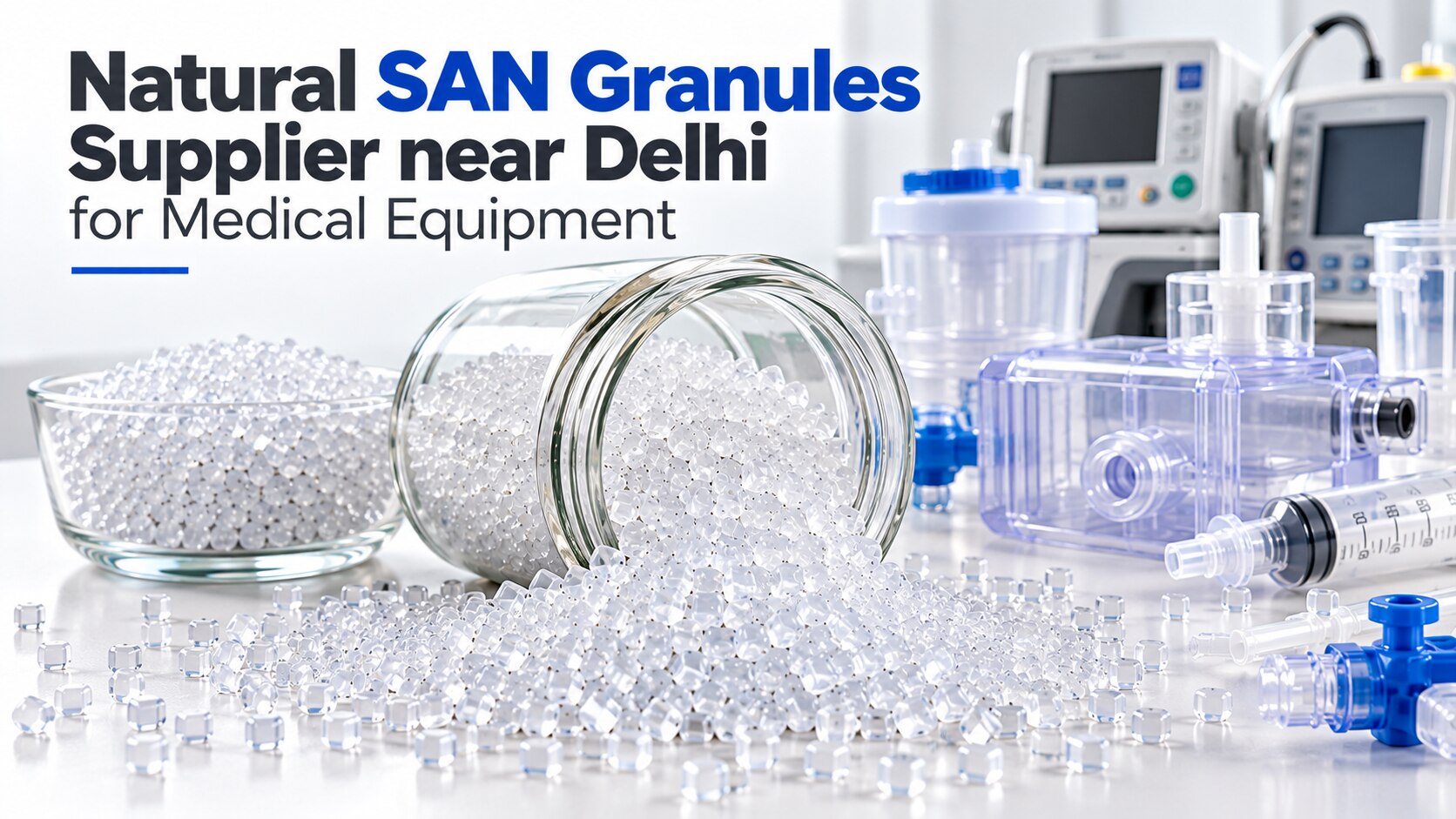
Medical-equipment moulders need more than a bag labelled natural SAN: they need a defined polymer grade, controlled colour, processing data and evidence that the material suits the part and its sterilisation cycle. By the end, you can separate a general-purpose resin from a traceable, technically suitable lot and prepare a supplier checklist for procurement near Delhi.
Key takeaways
- Separate virgin SAN from reprocessed SAN before comparing quotations.
- Request the lot COA, SDS, batch traceability and processing data.
- Check clarity, colour, contamination and odour before production approval.
- Run a documented trial lot before approving regular SAN granule supply.
What SAN is and which medical-equipment parts it suits
SAN means styrene-acrylonitrile copolymer: a resin made from styrene and acrylonitrile, not the rubber-modified structure used in ABS. Because SAN has no butadiene phase, it generally provides better transparency, gloss, dimensional stability and chemical resistance than ABS, but much lower impact toughness.
| Material | Compared with SAN | Main trade-off |
|---|---|---|
| GPPS | Lower chemical and stress-crack resistance | Usually clearer, but less resistant |
| HIPS | Better impact protection | SAN provides better clarity |
| Polycarbonate | Better impact resistance and heat or sterilisation performance | Usually less transparent and more costly |
Natural SAN normally means unpigmented or translucent resin in its supplied colour. It does not prove that the material is virgin, recycled, biodegradable or bio-based; ask separately about material history.
Natural SAN suits transparent or translucent housings, covers, viewing panels, trays and non-sterile laboratory components when the design does not depend on high impact strength, repeated autoclaving or validated medical-contact status. A general-purpose grade is not automatically medical grade.
Use another polymer when the part faces drops, pressure, steam autoclaving, gamma irradiation, ethylene oxide, repeated chemical sterilisation or direct patient contact without compliance evidence. These exposures can cause crazing, yellowing, embrittlement or dimensional change. Ask any natural san granules supplier in delhi for grade-specific compatibility data.
Do not infer flame resistance from the SAN name. Verify the exact UL 94 classification at the required part thickness, because formulation and thickness affect the result.
How to specify virgin, reprocessed or blended SAN before buying
Write the purchase request as a material identity, not simply “natural SAN.” Natural colour means unpigmented or translucent resin; it does not mean virgin, recycled, biodegradable or bio-based material.
1. Specify the original producer grade designation, acrylonitrile content when the application controls it, melt-flow specification, natural colour, packing size, origin and intended processing method. Ask whether the pellets are virgin, reprocessed, compounded or blended. A natural SAN granule manufacturer may produce resin, pelletise controlled production scrap, compound imported polymer or trade material.
Request the manufacturing location, batch traceability and lot-specific certificate of analysis.
2. For reprocessed SAN granules, record recycled-content percentage, post-industrial or post-consumer feedstock, number of thermal cycles if known, filtration, sorting method and maximum recommended share in the finished part. Repeated heat and shear can change molecular weight, melt flow, colour and impact strength.
Sorting errors can introduce ABS, HIPS, polycarbonate or other styrenics that look similar as pellets.
3. Require written approval before adding regrind to a medical-equipment part. A lower price does not prove equivalence to virgin resin. Put the permitted reprocessed percentage and lot limits in the purchase order, and reject material whose grade, source or processing history cannot be traced to the delivered batch.
Which technical data and processing instructions must accompany the lot
Request a technical data sheet and a lot-specific certificate before approving the material. The certificate must identify the grade, batch and test conditions; an isolated melt-flow number is not a reliable comparison. ISO 1133-1 and ASTM D1238 are common methods, but results taken at different temperatures or applied loads are not equivalent.
Ask for these values on both documents:
- Melt-flow rate, with test temperature and applied load
- Density and moisture content
- Tensile strength and impact strength
- Heat-deflection temperature and Vicat softening temperature
- Moulding shrinkage and colour value
Obtain the grade-specific processing window rather than copying an ABS guide.
| Parameter | Record from supplier | Risk if missing |
|---|---|---|
| Drying | Temperature and time | Surface moisture can cause silver streaks, splay and bubbles |
| Injection | Melt-temperature range, screw speed and back pressure | Incomplete filling or thermal degradation |
| Moulding | Mould temperature, holding pressure and cooling requirement | Distortion, weld lines or dimensional variation |
| Material control | Residence-time limit, permitted regrind percentage and clean-out procedure | Black specks, contamination or degraded resin |
Keep pellets sealed and dry them when storage exposure or the grade instruction requires it, even though SAN absorbs less water than nylon or PET. Run a trial on the actual machine and geometry; check fill, weld lines, shrinkage, dimensions and appearance before production approval.
Buyers sourcing SAN granules in Delhi should also require the lot’s maximum residence time and regrind limit in writing.
How to check clarity, colour and medical suitability before production
Reject the lot before production if pellets show yellowing, haze, black specks, gels, dust, mixed colours, or pellets with a different shape or transparency. Pellet appearance alone cannot predict optical clarity: mould a standard plaque and compare its colour and haze with an approved retained sample.
| Check | What to record | Acceptance basis |
|---|---|---|
| Visual inspection | Yellowing, haze, specks, gels, dust, mixed colours and pellet variation | Written contamination and appearance limits |
| Plaque comparison | Colour and haze against the retained sample | Agreed instrument method or controlled visual standard |
| Incoming tests | Identity, colour, melt flow, moisture, density, and ash or inorganic contamination | Named method, temperature, load and batch limit |
| Sterilisation trial | Steam, ethylene oxide, gamma or chemical exposure | No unacceptable crazing, yellowing, embrittlement or dimensional change |
Define acceptable batch-to-batch colour variation before ordering. Ask a natural SAN granules supplier in Delhi for the batch number, production date, certificate of analysis, named test methods and conditions, retained sample, and records linking the pellets to source feedstock.
For medical equipment, request ISO 10993 biological-evaluation data, cytotoxicity results, USP Class VI testing where applicable, extractables and leachables information, a medical-contact declaration, and written change-control commitments. A general-purpose SAN grade is not validated medical resin.
Confirm the exact grade against the part geometry, exposure count and sterilisation cycle; heat, radiation and chemicals can damage an otherwise clear part.
How to evaluate a Delhi NCR supplier and approve a trial lot
A natural SAN granules supplier in Delhi must be judged on technical control, not delivery speed alone. Ask whether the seller is an original producer, distributor, reprocessor or trader; whether bags are factory sealed; and whether the same grade and batch can be replenished.
Treat a seller calling itself a natural san granule manufacturer as unverified until it provides the manufacturing location, original producer grade, certificate of analysis and batch traceability.
| Supplier type | Evidence to request | Main trade-off |
|---|---|---|
| Original producer | Grade designation, production site and lot records | Strongest source control |
| Distributor | Factory-sealed bags and producer documents | Good traceability, less control over supply |
| Reprocessor | Feedstock, sorting, filtration and recycled percentage | Lower cost, greater lot variation |
| Trader | Source, sealed packaging and complete documents | Convenience, highest verification burden |
For san granules in delhi, order a small trial lot. Mould representative parts on the intended machine and compare dimensions, colour, surface defects and process stability with the certificate and incoming-test results. Retain one unopened bag or sample as the reference.
Write these acceptance criteria into the purchase order:
- Virgin or recycled-content status and allowable reprocessed percentage
- MFR test temperature and load, moisture limit and colour tolerance
- Contamination limit, required documents and batch identity
- Notification before formulation, source or grade changes
PLASTO INDIA AND POLYMERS can be one Delhi NCR comparison point; approve the material, not the label. Reject any lot whose data cannot be tied to the delivered batch.
Related product
 | Reprocess ₹160 *Desiccant*: SAN granules are effective desiccants, used to control humidity and moisture in various industries, such as pharmaceuticals, food, and... View product → |
Frequently asked questions
What medical-equipment parts suit SAN granules?
SAN suits parts that need transparency, gloss, dimensional stability and chemical resistance but do not face high impact. Review the design before using it for load-bearing or impact-exposed parts because SAN has lower toughness than ABS.
How do virgin, reprocessed and blended SAN differ?
Virgin SAN is made from unused resin. Reprocessed SAN contains recovered material and requires tighter checks for colour, contamination, melt flow and performance. A blended grade combines virgin and reprocessed material, so request the blend ratio and lot-specific test data.
Which documents should accompany a SAN granule lot?
Request the certificate of analysis, safety data sheet, batch or lot number, resin grade, manufacturing date, colour specification, melt-flow result, moisture guidance and processing recommendations. Ask for a written declaration identifying virgin, reprocessed or blended content.
How can you approve a Delhi NCR SAN supplier's trial lot?
Match the delivered label and batch number to the documents, inspect granules for colour variation and contamination, then mould representative parts. Record appearance, dimensions, odour, processing settings and test results before approving repeat supply.
Keywords