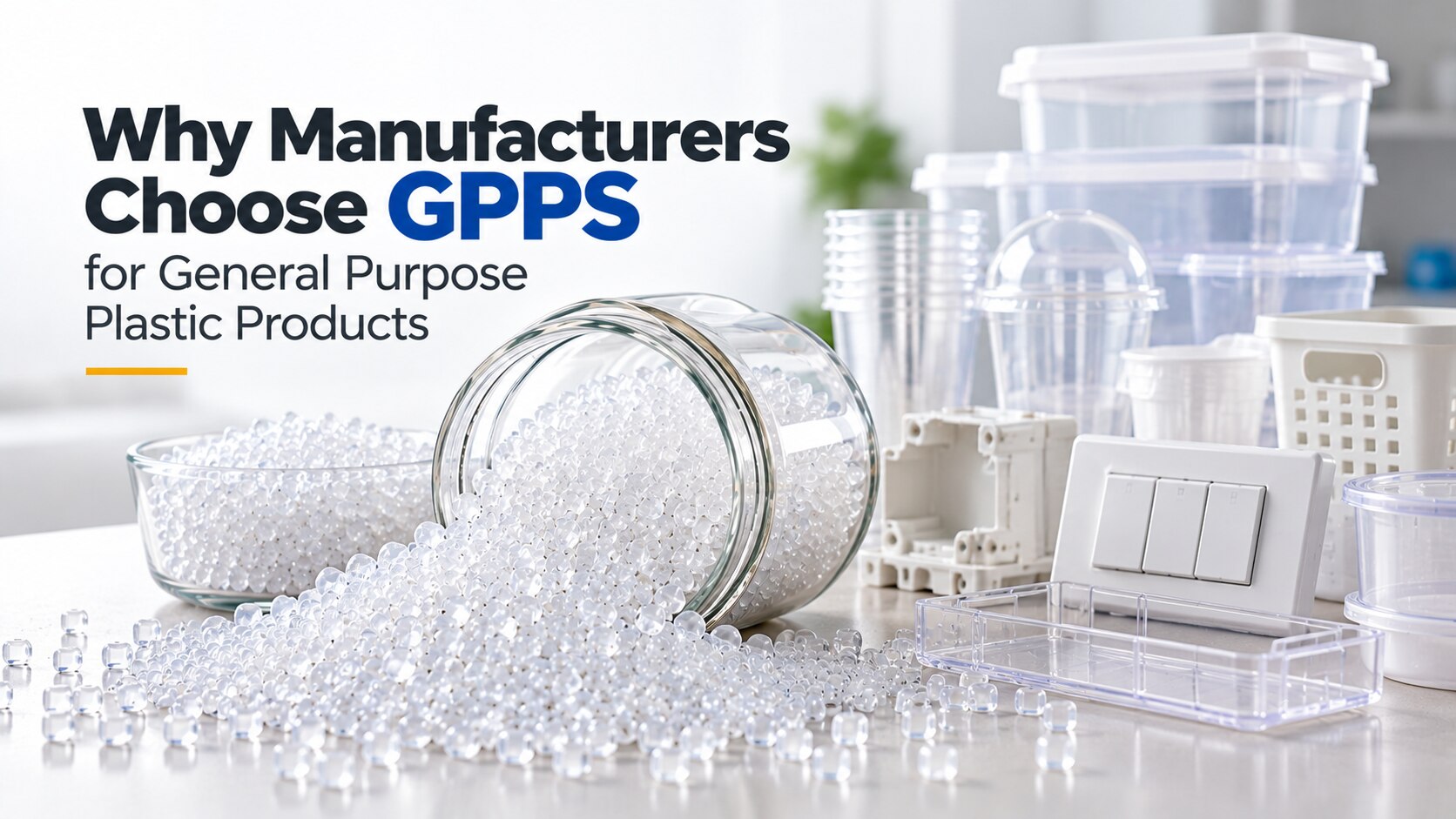
Choosing a resin involves more than finding the lowest-cost plastic granules. By the end, you will know when GPPS earns its place through clarity, gloss, stiffness and efficient processing—and when HIPS, ABS, PP or SAN is the safer choice.
Key takeaways
- Choose GPPS for rigid, clear parts with a smooth glossy finish.
- Use HIPS, ABS, PP or SAN when impact, heat or chemical resistance matters more.
- Match GPPS grade to clarity, flow, stiffness and the product’s moulding requirements.
- Check certificates, batch details, packaging and contamination before accepting plastic granules.
What GPPS gives manufacturers beyond low material cost
A manufacturer selects GPPS when the part must look clear, feel rigid and come out of the mould with a smooth, glossy surface. Its amorphous structure supports optical clarity without the crystallisation-related changes that complicate cooling, helping transparent parts retain a consistent appearance and shape.
GPPS manufacturer benefits include:
- Clarity that can remove a separate colouring or coating operation, reducing handling and processing steps.
- Easy flow through injection moulds, extruders and thermoforming equipment, including relatively thin or detailed sections.
- Predictable filling and repeatable cycles when the grade, melt temperature, mould temperature and residence time are properly matched.
- Low moisture absorption, which supports dimensional and electrical consistency without the intensive drying used for moisture-sensitive polymers.
- A density near 1.04–1.06 g/cm³, giving a practical balance between part weight and stiffness; confirm the exact value on the grade datasheet.
GPPS also delivers good electrical insulation and holds dimensions reasonably well because it does not undergo a large crystallisation change during cooling. That combination suits display components, transparent packaging, laboratory disposables and rigid housings.
The trade-off is brittleness. Choose another material when the product faces repeated impact, outdoor weather, high heat or aggressive chemicals; adding modifiers can reduce GPPS clarity and erase its processing or cost advantage.
When HIPS, ABS, PP or SAN is the better polymer
Switch from GPPS when the product must survive impact, flex repeatedly, tolerate higher heat, resist chemicals or remain reliable outdoors. GPPS is rigid and glossy, but its low toughness makes a thin housing crack after a drop, while prolonged exposure near its roughly 95–105 °C glass-transition range can cause distortion and stress cracking.
| Polymer | Product requirement | Why it is the better choice |
|---|---|---|
| HIPS | Drop resistance for appliance liners, trays or housings | Its rubber phase absorbs impact; accept lower transparency and do not treat it as a complete solution for long-term outdoor exposure. |
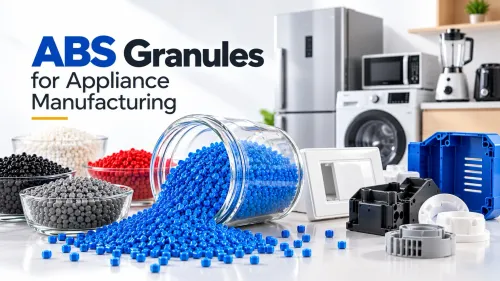
| ABS | Toughness plus a durable, finished housing | It combines impact resistance, stiffness and better heat performance than GPPS; use a weatherable grade for exterior parts. |
| PP | Flexing, hinge action, low density, chemical contact or hot washing | PP tolerates repeated bending and many chemicals, but its lower stiffness and different shrinkage can complicate dimensional control. |
| SAN | Clarity with higher chemical and heat resistance | SAN retains a clear appearance while improving resistance to oils and some chemicals; it still is not an impact-grade replacement. |
Choose HIPS or ABS when a dropped or struck part must remain intact. Choose PP when the part needs a living hinge, squeeze action or contact with detergents and solvents. Choose SAN when clarity matters but GPPS would craze or lose strength in the service environment.
For outdoor products, specify UV protection and validate the complete formulation and design; simply changing GPPS to HIPS does not guarantee weatherability. Also check the actual service temperature, chemical exposure and impact test before accepting a substitute.
How moulding conditions affect GPPS performance
GPPS fills thin walls when the melt reaches the mould before its flow front freezes. Set the melt and mould temperatures within the resin datasheet range, then use sufficient injection speed and pressure; a cold mould, slow fill or undersized gate can leave short shots, flow marks and visible weld lines.
Use this checklist before approving the mould and process:
- Keep wall thickness as uniform as possible. Sudden changes create uneven cooling, sink, warpage and locked-in stress; transition gradually with core-outs or stepped sections.
- Place gates to shorten the flow path and keep weld lines away from clips, screw bosses, sharp corners and other loaded features. A weld line in a thin section can become the starting point for a brittle crack.
- Add generous radii to external and internal corners. Sharp notches concentrate stress, so they can fracture during ejection, assembly or a minor impact even when the moulded surface looks perfect.
- Vent the end of fill and around ribs, bosses and inserts. Trapped air burns the GPPS or prevents complete filling, forcing higher pressure that increases residual stress.
- Use pack and hold pressure long enough to compensate for volumetric shrinkage, then allow adequate cooling before ejection. Removing a hot part too early can distort dimensions.
- Dry pellets only when the shipment has absorbed moisture or contains condensation; GPPS has low moisture absorption, but contaminated feedstock can still cause bubbles and surface defects.
- Keep service temperatures well below the grade’s roughly 95–105°C glass-transition range. Heat near that range reduces stiffness and dimensional stability, while impact-modified HIPS is the safer choice for repeated удар or notch loading.
How to match the GPPS grade to the product
Choose transparent GPPS when the product must show its contents, transmit light or deliver a glass-like gloss. Choose opaque GPPS when privacy, colour consistency or concealment matters more than optical clarity; pigment also hides minor colour variation and recycled-content effects.
| Option | What to check | When it applies |
|---|---|---|
| Transparent or natural CP | Haze, yellowness, black specks, flow grade and wall-thickness uniformity | Lenses, clear packaging, display parts and products where appearance is functional |
| Opaque or pigmented GPPS | Colour match, pigment compatibility, surface gloss and streaks around gates or weld lines | Housings, trays, caps and parts where contents stay hidden |
| Thin-wall design | Melt-flow data, filling pressure and stress whitening after ejection | Detailed sections; a low-thickness design can expose flow marks or brittle corners |
| Thick-wall design | Cooling time, sink marks, internal stress and dimensional change | Solid bosses or heavy sections; uneven thickness can distort appearance |
Do not treat “natural” as a compliance claim. CP granules and natural cp are trade descriptions, not universal international grade classifications, so confirm the producer’s designation and datasheet.
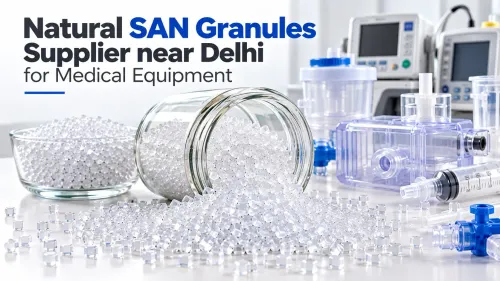
For food-contact products, request a declaration covering the exact grade, additives, colourants, residual substances and intended food type under your jurisdiction’s rules. Medical parts need separate evidence for the application, including cleanliness, biocompatibility and compatibility with the planned sterilisation method.
If recycled content is required, specify the percentage, source, segregation and traceability. Recycled GPPS can introduce haze, odour, colour variation or contamination, making it unsuitable for clear, food-contact or medical parts without documented approval.
What to verify before accepting a shipment of GPPS granules
A clean, glossy pellet is not proof that GPPS is virgin. Reprocessed material can look identical after filtration and pelletising, so confirm origin through documents, traceability and testing rather than colour alone.
1. Match the bag, seal and label to the purchase order. Record the producer’s grade, lot number, production date, quantity and “natural CP” or colour designation. “CP granules” means crystal polystyrene in trading language, not a universal grade name; confirm the producer’s exact GPPS designation.
2. Request the certificate of analysis for that lot and compare density, melt-flow rate, colour, ash, moisture and any agreed impact or recycled-content limit with the datasheet. GPPS density commonly falls near 1.04–1.06 g/cm³, but the manufacturer’s value controls. A density check supports identification; it does not prove virgin content.
3. Inspect a representative sample for uniform pellet size, excessive fines, black specks, mixed colours, dust, burnt odour and inconsistent transparency. These signs can indicate contamination or thermal history, but their absence does not certify virgin resin. Require a written declaration stating whether recycled or reprocessed material is present.
4. Compare MFR only under the same ASTM D1238 temperature and load. “MFI 8” without those conditions is not a valid comparison between suppliers. Retain sealed reference samples and test disputed lots before moulding.
Keep the shipment quarantined if the lot number, COA or seal is missing. PLASTO INDIA AND POLYMERS can provide the agreed grade documents and sample details before your manufacturer releases plastic granules to production.
Related product
 | # GPPS Plastic Dana Manufacturers in Delhi GPPS (GENERAL PURPOSE POLYSTYRENE) ₹108 We are the leading Manufacturers & Suppliers of GPPS (GENERAL PURPOSE POLYSTYRENE) DANA. View product → |
Frequently asked questions
What are the main GPPS manufacturer benefits?
GPPS provides optical clarity, rigidity, a smooth glossy surface and consistent dimensions for general-purpose moulded products.
When is HIPS, ABS, PP or SAN better than GPPS?
Choose HIPS for improved impact resistance, ABS for toughness and heat performance, PP for low density and chemical resistance, and SAN for better chemical resistance with clarity.
How do moulding conditions affect GPPS performance?
Incorrect melt temperature, injection speed, cooling or mould temperature can cause warpage, flow marks, sink marks, brittleness or reduced surface quality.
How should you match a GPPS grade to a product?
Compare the grade’s melt flow, clarity, stiffness, impact performance, colour and processing range with the product design and moulding equipment.
What should you verify before accepting GPPS granules?
Check the supplier name, grade, batch number, manufacture date, technical data sheet, certificate of analysis, packaging seal and signs of moisture or contamination.
Keywords