A quotation marked “natural SAN” does not tell you whether the pellets are virgin, reprocessed or blended, nor whether they will produce clear, stiff and consistent parts. By the end, you will be able to match SAN to stationery and toy components, specify moulding conditions, test incoming batches and reject material that threatens appearance, durability or toy compliance.
Key takeaways
- Confirm whether the SAN is virgin, reprocessed or blended on the quotation and COA.
- Choose SAN for clarity and stiffness, not impact-heavy toy parts.
- Control melt temperature, mould temperature and drying to protect dimensions.
- Test colour, moisture, impact, flow and shrinkage before approving a batch.
What natural SAN means for stationery and toy parts
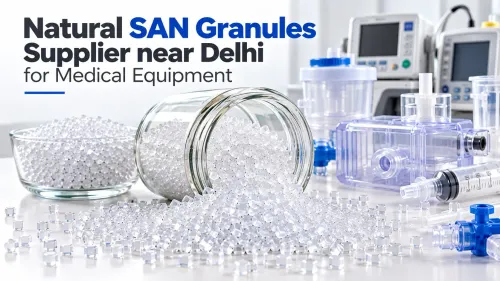
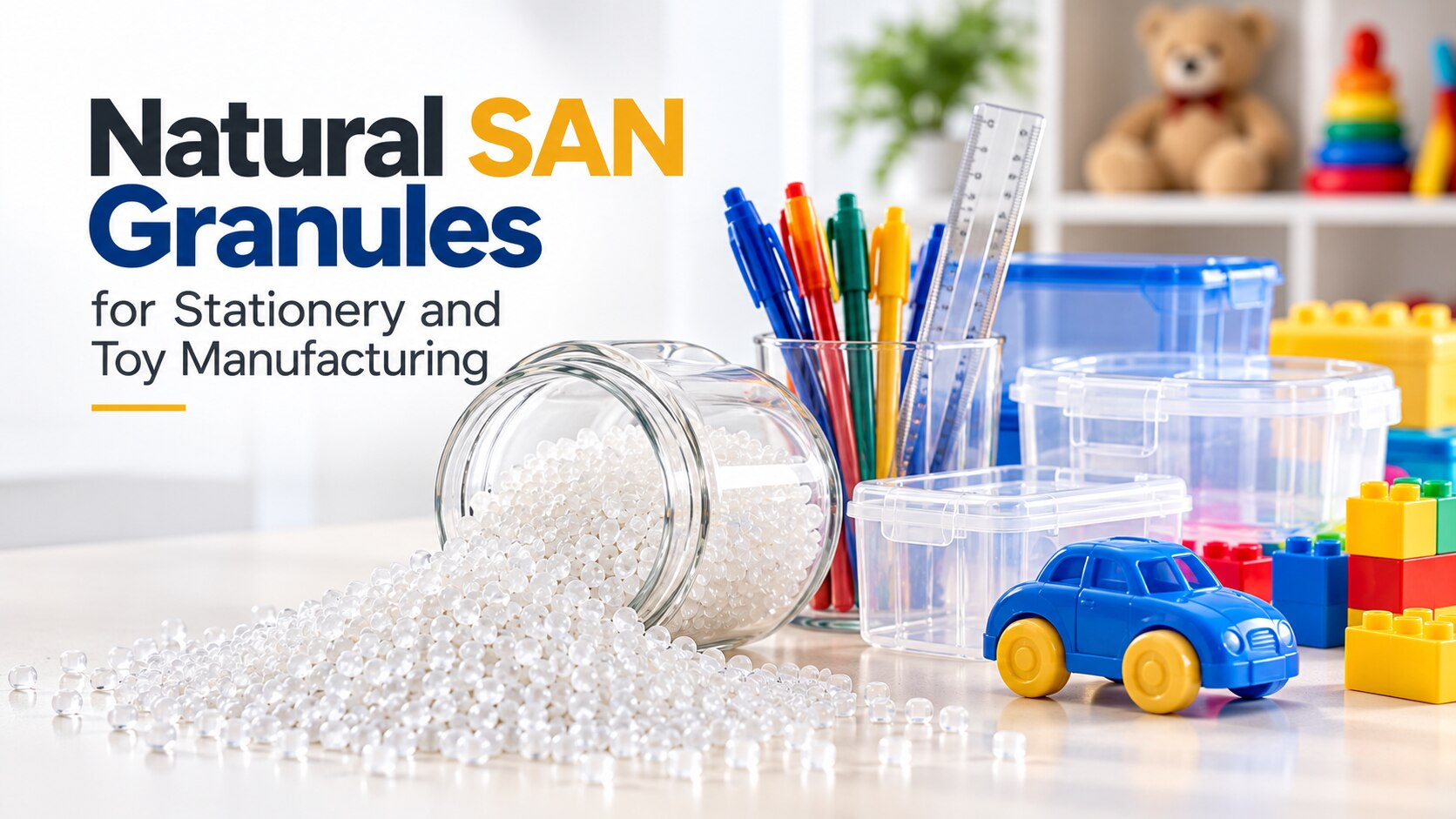
Natural SAN granules are an unpigmented styrene-acrylonitrile copolymer with a translucent-to-clear appearance. “Natural” describes the absence of added colour; it does not prove virgin origin. Confirm virgin resin, reprocessed SAN or a blend on both the quotation and the certificate of analysis.
| Application | Suitable parts | Boundary to check |
|---|---|---|
| Stationery | Pen barrels, rulers, geometry sets, transparent files, folders, desk-organiser parts and other rigid items | Choose it when stiffness, surface finish and controlled clarity matter |
| Toys | Toy windows, rigid housings, handles, structural inserts and visible moulded details | Use it for rigid features that do not need repeated impact absorption |
A clear-looking pellet is not a complete quality specification. Ask for controls on haze, yellowness, black-speck count, flow consistency and moulded-part stress; a colour description alone will not prevent optical distortion, contamination or cracking.
Standard SAN suits rigid stationery and display-facing toy details, but a handle exposed to drops, a snap-fit or a part designed to absorb repeated abuse needs an impact-modified polymer instead. Confirm the resin identity and these optical limits before approving a grade.
Natural SAN versus ABS SAN, GPPS and HIPS
Choose natural SAN for rigid, clear stationery or toy details when stiffness, transparency and surface finish matter; choose impact-modified ABS or another resin when the part must absorb abuse.
| Option | Stiffness and transparency | Impact resistance | Surface, chemical resistance and colourability |
|---|---|---|---|
| Natural SAN | Stiffer and clearer than ABS; transparent grades suit windows and visible parts | Lower because it is normally non-rubber-modified | Smooth, glossy finish; stronger chemical and heat resistance than GPPS; colours cleanly |
| ABS | Less clear and less stiff because its SAN-type matrix contains rubber, commonly polybutadiene | Tougher and better for drops, snaps and repeated flexing | Good moulded finish and broad colourability; rubber modification changes chemical and optical behaviour |
| GPPS | Very clear and rigid, but less chemically and heat resistant than SAN | Brittle under impact | Glossy and easy to colour; cracking follows drops or stressed assembly |
| HIPS | Rubber-modified and less transparent than SAN | Tougher than GPPS, with improved impact resistance | Usually opaque; colours readily, while rubber modification changes shrinkage and finish |
Do not treat the description “abs san” as natural SAN. ABS can replace it only when toughness matters more than clarity, such as snap-fits, handles exposed to drops, repeatedly flexed parts and toy components expected to absorb abuse.
Substituting ABS changes clarity, shrinkage, impact performance and processing behaviour. A natural-SAN mould trial cannot validate an ABS replacement: fill pattern, packing, cooling and final dimensions must be checked again. Choose another impact-modified resin if ABS still lacks the required chemical resistance or colour consistency.
Moulding conditions that protect clarity and dimensional accuracy
Protect clarity and dimensional accuracy by specifying the resin and the moulding process together. Do not accept “natural SAN” as a complete processing instruction.
1. Require the supplier’s grade datasheet to state melt-flow rate, test temperature, load and conditioning method. Record the grade-specific shrinkage value; do not use a generic SAN shrinkage constant for tool design.
2. Obtain drying temperature, drying time and maximum permitted moisture. Wet resin causes splay, bubbles, silver streaks, poor surface quality and unstable properties.
3. Keep melt temperature stable within the grade datasheet range. Control residence time, because prolonged exposure to excessive temperature creates yellowing, odour, streaks and optical loss.
4. Check the machine before production: clean the screw and barrel, confirm adequate mould venting, and use balanced filling. Set a suitable mould temperature and restrain packing pressure and time to reduce moulded-in stress, sink marks and distortion.
5. Stabilise the machine before approval. Run a purge check, then retain first-off samples and compare them with agreed limits for haze, colour, weld lines, sink marks and dimensions.
6. Define the dimensional method, measurement points and tolerances on the drawing. Inspect critical features after the part has cooled under the agreed conditioning period, not immediately after ejection.
7. Approve the lot only after trial samples meet the limits. Record the machine settings, cavity identification and batch number so a later defect can be traced to material or process.
How to buy and test virgin or reprocessed SAN in Delhi
1. Treat “natural SAN” as a colour description, not proof of virgin resin. Ask whether the seller manufactures base resin, compounds additives, pelletises purchased material, distributes it or trades it.
A natural san granules manufacturer supplier in delhi may actually supply compounded or reprocessed feedstock, so request the upstream resin identity, manufacturer code, additives, other polymers and batch records.
2. Put every acceptance point in the purchase order: polymer family, manufacturer code, virgin or reprocessed status, natural-colour requirement, MFR test temperature and load, conditioning method, package size, permitted regrind percentage, batch traceability and certificate-of-analysis delivery. Without these fields, two quotations from a plastic granules supplier in delhi can describe different materials.
3. For reprocessed san granules, inspect pellets and moulded plaques. Reject or investigate black specks, foreign polymer, pigment traces, odour, brittleness and inconsistent flow. Require lot-specific MFR under the same ASTM D1238 temperature, load and conditioning, then check moisture, density, ash or inorganic contamination, haze, colour and an agreed speck limit.
Similar MFR values do not prove equal clarity or chemical resistance.
4. Evaluate PLASTO INDIA AND POLYMERS as a Delhi NCR supplier by requesting upstream resin identity, batch records and a production trial, rather than accepting “natural SAN” as a complete specification. Mould plaques on the intended machine and compare optical appearance, flow and breakage; a pellet sample alone cannot expose contamination or degraded performance.
Related product
 | Reprocess ₹160 *Desiccant*: SAN granules are effective desiccants, used to control humidity and moisture in various industries, such as pharmaceuticals, food, and... View product → |
When to approve SAN for a finished stationery or toy product
Approve the finished part, not the pellet sample. Reprocessed SAN granules are unsuitable where you need highly consistent transparency, tight colour matching, low odour or dependable snap-fit performance unless the lot passes agreed production trials.
Take first-off and end-of-run samples after the moulding process stabilises. Compare:
- Haze, yellowness, black-speck count, dimensions and gloss
- Weld lines, fit, flexing and breakage
Test the actual geometry against the chemicals it will meet: cleaners, alcohol-rich liquids, oils, adhesives, inks and concentrated surfactants. SAN can develop environmental stress cracking, so a datasheet cannot clear a stressed part.
For toys sold in India, check the Toys Quality Control Order and the applicable Bureau of Indian Standards requirements for the finished article and its components. The IS 9873 series covers relevant mechanical and physical, flammability and chemical requirements; electric toys also require the applicable IS 15644 requirements.
A resin designation alone does not establish toy compliance.
| Option | What it means | When it applies |
|---|---|---|
| Natural SAN | Clear, stiff, surface-finished and colourable, but not impact-modified | Rigid stationery, windows and visible toy details |
| ABS | Rubber-modified, tougher and less transparent | Durable handles, snap-fits and repeated-impact parts |
Approve only when the documented batch, moulded samples and finished-product tests match the intended use. Select ABS or another impact-modified polymer when durability outweighs clarity.
Frequently asked questions
What does natural SAN mean for stationery and toy parts?
Natural SAN is unpigmented styrene-acrylonitrile copolymer with a translucent-to-clear appearance. Natural describes colour, not virgin origin, so confirm the resin history separately.
How does natural SAN compare with ABS SAN, GPPS and HIPS?
SAN offers clarity and stiffness. ABS SAN grades add rubber modification for higher impact resistance, GPPS offers clarity but lower impact strength, and HIPS sacrifices clarity for improved toughness.
Which moulding conditions protect SAN clarity and dimensional accuracy?
Use the grade supplier’s melt and mould-temperature window, dry resin when its technical data sheet requires it, keep the melt residence time short, and control cooling and injection speed.
How should you buy and test virgin or reprocessed SAN in Delhi?
State the required resin history, colour, grade and application on the purchase order. Check the batch number and certificate of analysis, then test moisture, melt flow, colour, impact and dimensions against an approved reference.
When should SAN be approved for a finished stationery or toy product?
Approve it only after the moulded part meets appearance, dimensional, assembly and functional requirements, including impact performance when the product will be dropped, squeezed or repeatedly handled.
Keywords