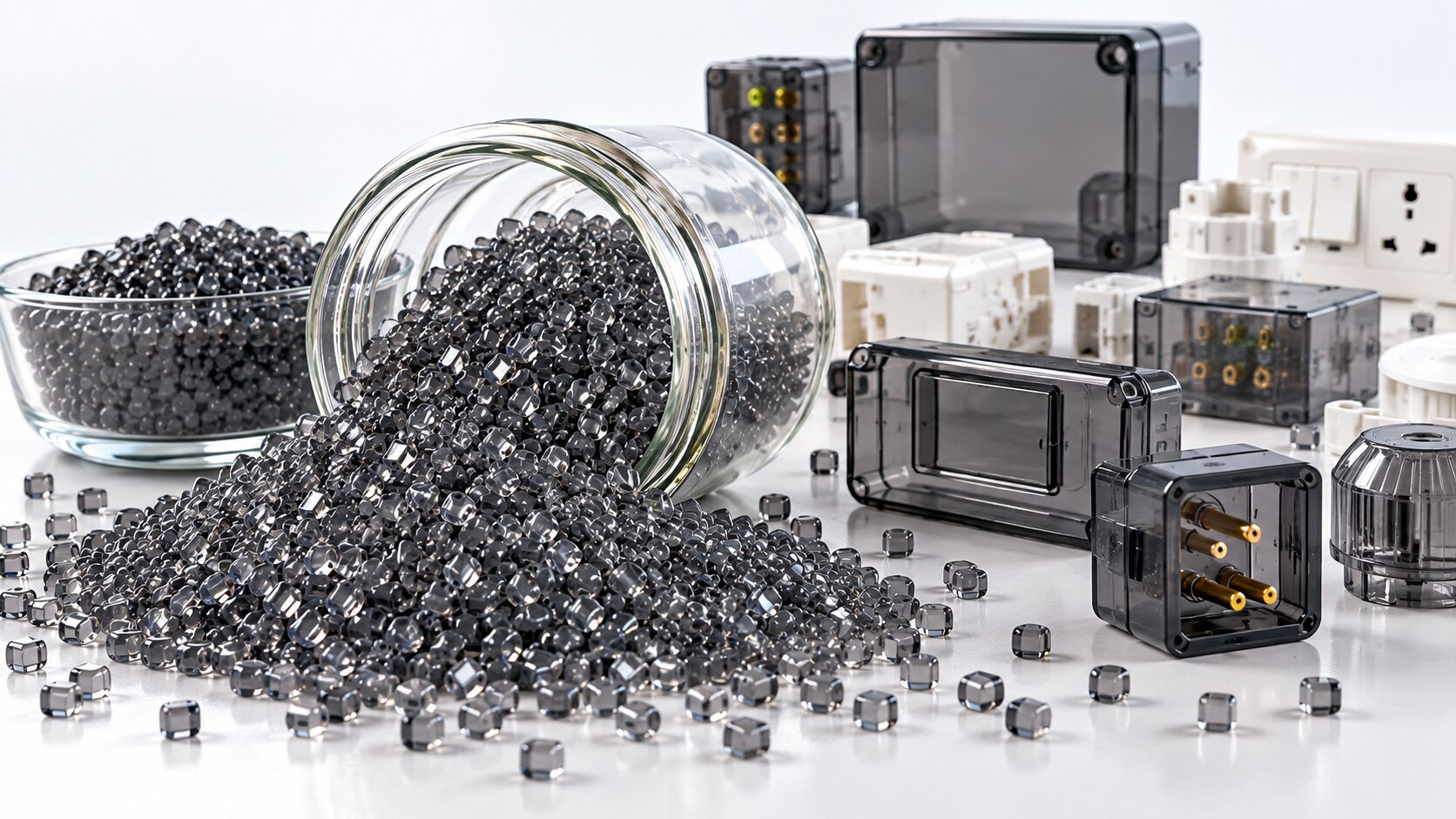
“Smoke crystal” describes an appearance, not a guaranteed resin, insulation class or flammability rating. Before you order, identify the base polymer, define the electrical tests and colour tolerance, then confirm that the material processes consistently in your actual mould.
Key takeaways
- Identify the base polymer before comparing smoke crystal granules.
- Match electrical test results to wall thickness and test method.
- Separate virgin, reprocessed and compounded material risks.
- Approve a lot only after moulding trials and documented tests.
What smoke crystal means before you choose a resin
Smoke crystal is not a universally defined plastic grade; it is a commercial colour and appearance description. Identify the base polymer—GPPS, HIPS, SAN, ABS, PC, PET or a blend—and obtain its specification. ASTM D7611 identifies resin families by polymer type, not by names such as smoke crystal.
| Resin | Electrical parts it may suit | Main limitation to verify |
|---|---|---|
| GPPS | Rigid terminal covers, light-fitting parts and transparent inspection windows | Brittle; check impact and heat resistance |
| HIPS | Switch housings, terminal covers and appliance components | Usually less transparent; verify insulation and flammability |
| SAN | Clear appliance bezels and inspection parts | Check stress cracking and temperature performance |
| ABS | Switch housings, enclosures and appliance components | Smoke appearance does not prove a required UL 94 rating |
| PC or PC/ABS blend | Heat-exposed housings, covers and switchgear parts | Confirm blend composition, dielectric data and moulding temperature |
Use smoke crystal granules for a component only after matching the resin to its service conditions. A clear or translucent pellet is not automatically an electrical insulator, and colour cannot prove volume resistivity, dielectric strength, insulation resistance, comparative tracking index or UL 94 performance.
Do not approve material for a mains barrier, arc-prone part, high-temperature connector or safety-critical enclosure from appearance alone. Require the resin identity, virgin or recycled content, and test results made on specimens of stated thickness; then test the finished component under its applicable product standard.
Electrical figures must match the resin, test method and wall thickness
A catalogue saying “electrical grade” does not prove that smoke crystal granules will insulate your part. Require a lot-specific certificate of analysis (CoA), the resin datasheet, and test reports showing the polymer type, virgin or recycled content, melt flow, density, ash or filler, moisture, colour tolerance and flammability rating.
| Property | Document or method | What you must match |
|---|---|---|
| Volume and surface resistivity | ASTM D257 report | Specimen conditioning, temperature, humidity and resin grade |
| Dielectric breakdown strength | ASTM D149 report | Electrode arrangement, specimen thickness and test medium |
| Comparative tracking index | IEC 60112 report | Test voltage and the exact compound tested |
| Flammability | UL 94 report or UL Yellow Card | V-0, V-1 or V-2 rating at the tested thickness |
| Finished-part insulation | Component test record | Insulation resistance, creepage, clearance and product-standard requirements |
A report is useful only when its specimen matches your material and moulding condition. A UL 94 V-0 result at 3.2 mm does not establish V-0 at a 1.0 mm housing wall, and ASTM D149 values from a different polymer blend do not qualify your pellets.
Ask any smoke crystal for plastic dana manufacturer in delhi for the test date, lot number, specimen thickness and laboratory identity. For recycled or compounded dana, reject generic catalogue figures unless the supplier links them to the offered batch.
Approve the finished component separately; pellet data cannot replace abnormal-heat, flammability or insulation testing required by the appliance standard.
Virgin, reprocessed and compounded material are different purchasing risks
A virgin pellet, a reprocessed pellet and a compounded pellet are not interchangeable purchasing risks. Reprocessing can introduce polymer contamination, moisture, ash and thermal degradation; those changes can reduce dielectric consistency, impact strength and melt-flow stability even when every pellet looks smoke-crystal.
| Material type | Purchasing risk | Batch-approval evidence |
|---|---|---|
| Virgin | Lower unknown contamination risk, but the claimed resin grade still needs proof | Resin grade, lot certificate, melt-flow result and manufacturer traceability |
| Reprocessed | Repeated heat history and mixed scrap can shift colour, flow, strength and insulation performance | Lot-specific test results, source description, filtration details and recycled-content declaration |
| Compounded | Additives, filler, pigment or flame retardant change the base resin’s behaviour | Formulation or additive declaration, ash or filler result, colour standard and finished-lot data |
A defined colour is part of approval, not decoration. Specify a reference plaque, illuminant and tolerance using CIE L*a*b* difference calculations under ASTM D2244; visual matching under warehouse lighting can accept a lot that later fails beside the approved component.
Put these fields in the purchase specification:
- Polymer identity, virgin or recycled percentage, melt-flow condition, density, moisture and ash or filler limit
- Colour tolerance, reference plaque number and packaging identification
- Lot number, production date, test results and retention-sample policy
A search for manufacturer plastic granules in delhi identifies a location claim, not manufacturing capability. Verify whether the seller extrudes the pellets or trades them, and where sorting, grinding, compounding, filtration and packing occur. Approve the finished electrical part separately: “electrical grade” on a catalogue sheet does not replace flammability, insulation or abnormal-heat testing.
Set the moulding window and test the material before approving a lot
Approve a lot only after it passes both material identity checks and a trial in the customer’s mould. A smoke appearance can hide incompatible polymer, moisture or filler that later causes splay, weak weld lines or unstable insulation.
1. Confirm the polymer with FTIR or DSC, then compare the certificate and retained sample. Record the lot’s melt-flow rate at the specified test condition, density, moisture, ash or filler content and colour value. Do not accept appearance as identification; even a listing for plastic granules bawana does not prove composition.
2. Set drying from the identified polymer’s data sheet. Polycarbonate, polyamide and PET need controlled drying; inadequate drying produces bubbles, splay and molecular-weight loss. Record dryer temperature, time and dew point where applicable.
3. Establish a documented moulding window. Record barrel-zone temperatures, melt temperature, mould temperature, screw speed, back pressure, injection speed, hold pressure, hold time and cooling time. Run low, target and high settings around the approved condition, rather than approving one convenient shot.
4. Mould the actual electrical housing or a tool-equivalent plaque. Reject the lot if it shows short shots, burn marks, sink, warpage, dimensional drift, surface streaks or unstable cycle time.
5. Test representative mouldings for volume resistivity under ASTM D257 and dielectric breakdown under ASTM D149. Check the required UL 94 rating at the finished wall thickness; a V-0 result on a thicker plaque does not transfer automatically to a thinner housing.
How to compare a Delhi supplier for an electrical-grade order
A plastic dana manufacturer in Delhi earns your electrical order through traceability, not a smoke-crystal colour sample. Confirm who legally invoices you, where pellets are made, and whether the quoted GPPS, HIPS, SAN, ABS, PC or blend matches your drawing and end-product standard.
Request these items before approving production:
- A purchase specification stating polymer type, virgin or recycled content, melt-flow condition, density, ash or filler percentage, moisture limit, colour tolerance and required UL 94 rating.
- The manufacturing address, equipment list, and a plant visit covering sorting, grinding, compounding, melt filtration and final packing.
- A lot-specific certificate showing test results, batch number, production date and retain-sample policy. A catalogue sheet is not evidence for recycled material.
- Test specimens and methods behind electrical figures; ask for volume resistivity, dielectric strength, insulation resistance, comparative tracking index and UL 94 thickness.
- A written change-control rule for resin source, recycled percentage, pigment, filler and processing conditions.
| Supplier model | Verify before ordering | Main risk |
|---|---|---|
| Manufacturer | Extrusion line, filtration, laboratory and batch records at its site | Claimed capacity may differ from actual output |
| Compounder | Base resin, additive package and formulation control | Colour matches while flammability or dielectric results change |
| Reprocessor | Incoming sorting, contamination control and lot tests | Moisture, ash, degradation and melt flow vary |
| Trader | Original maker, sealed packaging and certificate chain | Seller cannot explain production or retain samples |
Whether you audit PLASTO INDIA AND POLYMERS or another supplier, require a pilot lot and mould your actual part. Supplier “electrical grade” wording cannot replace finished-component tests for flammability, insulation, creepage, clearance and abnormal heat.
Frequently asked questions
What does smoke crystal mean in plastic dana?
Smoke crystal describes colour and appearance, not a universally defined resin grade. Confirm whether the base polymer is GPPS, HIPS, SAN, ABS, PC, PET or a blend.
Which electrical figures should you compare between resins?
Compare dielectric strength, volume resistivity, insulation resistance, flammability rating and heat resistance using the same test method and matching wall thickness.
What is the purchasing risk of virgin, reprocessed and compounded material?
Virgin resin offers a traceable starting material, reprocessed resin requires tighter checks for degradation and contamination, and compounded material must be verified against its formulation and batch documents.
How should you approve a smoke crystal granules lot?
Set the moulding temperature, drying conditions, injection speed and holding pressure, then run trial parts and test them before approving the lot.
How do you compare a Delhi supplier for an electrical-grade order?
Ask for the polymer specification, batch number, certificate of analysis, material history, sample quantity, test method, delivery terms and traceability documents before placing the order.
Keywords