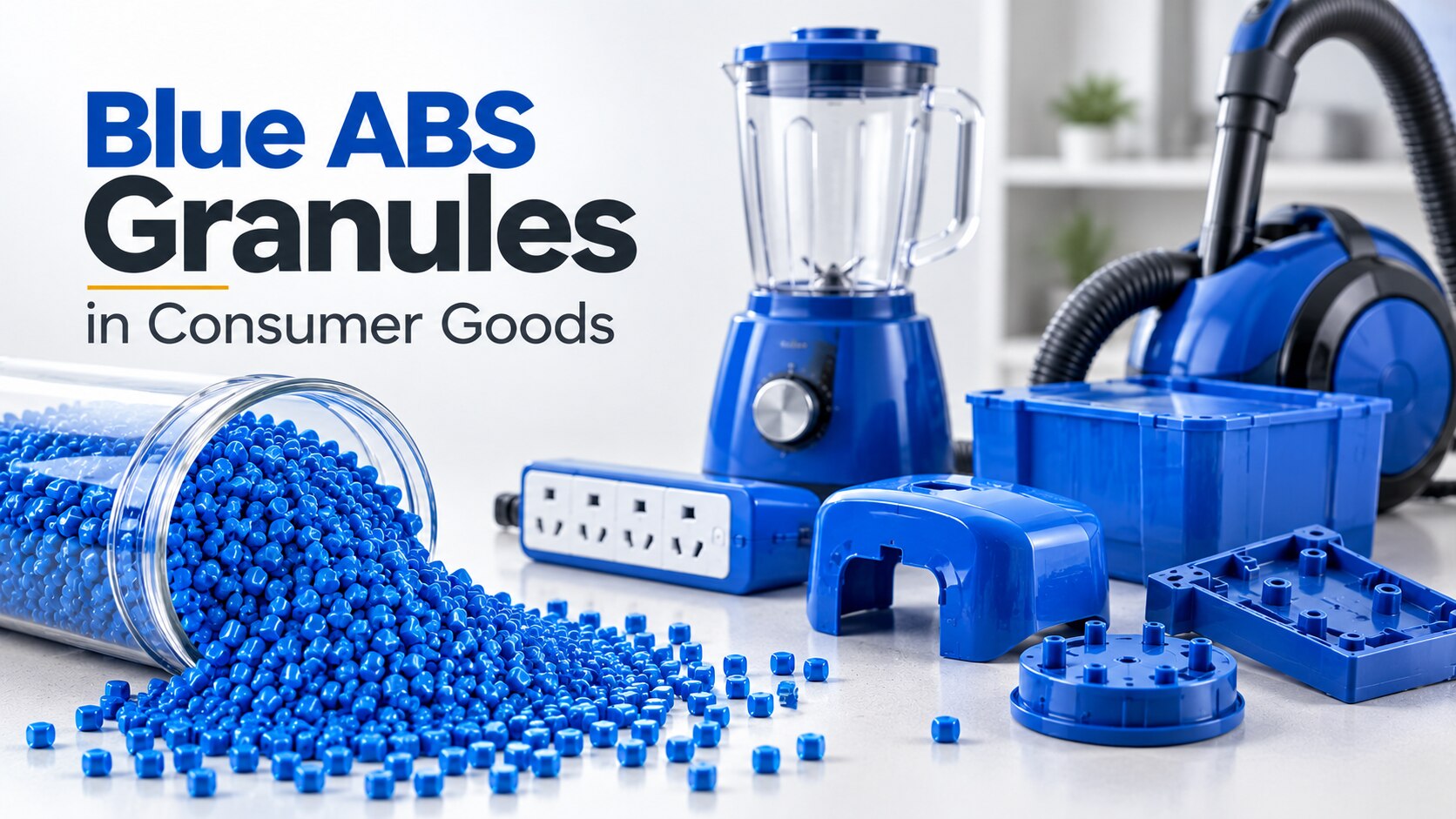
Blue ABS granules are chosen for more than their colour: the grade must fill the mould, survive impact, hold its shape and meet the product’s safety requirements. By the end, you will know which consumer parts use ABS, how to compare it with other plastics, and which test data and moulding trials to demand before approving a supply.
Key takeaways
- Choose ABS grade by impact, flow, heat and finish requirements—not colour alone.
- Approve blue colour using moulded plaques and finished parts under controlled lighting.
- Set drying, melt temperature, mould temperature and injection speed before comparing results.
- Check batch data, colour consistency, packaging and delivery terms before ordering in Delhi.
Why ABS suits everyday consumer products
ABS is an amorphous engineering thermoplastic selected for visible, impact-prone consumer parts because it combines chemical resistance, toughness and an attractive mouldable surface. Acrylonitrile contributes chemical resistance, butadiene adds impact toughness, and styrene supports rigidity, flow and finish. Blue ABS granules suit consumer goods granules applications such as:
- Appliance bezels
- Fan bodies, and blades or guards where the grade permits
- Electrical switch plates
- Tool housings
- Toy components
- Luggage shells
- Remote-control bodies
- Storage fittings
- Small household hardware
The alternatives change the trade-off:
| Material | Advantage | Limitation versus ABS |
|---|---|---|
| HIPS | Economical and impact-resistant | Different surface and stiffness balance |
| GPPS | Clear and rigid | Brittle under impact |
| SAN | Better chemical resistance and clarity | Less impact toughness |
| Polypropylene | Light and fatigue-resistant | Different shrinkage and surface behaviour |
| Polycarbonate | Higher impact and heat performance | Higher material cost and different processing requirements |
The phrase abs dana in delhi describes pelletized material sold locally, not one guaranteed grade. Before buying, specify the application, impact requirement, colour, processing method and virgin or recycled content.
A manufacturer should not approve a blue colour alone: two ABS grades can look identical in pellets yet produce different gloss, strength and dimensional results in the finished part.
Match the blue ABS grade to the part, not the colour
A luggage shell needs impact strength, while a switch plate needs stiffness. A manufacturer should select blue ABS granules by the part’s failure risk, not by colour or a generic “ABS” label.
| Part | Primary requirement | Confirm |
|---|---|---|
| Dropped housing or luggage | Notched Izod impact strength | Impact data at the required temperature |
| Switch plate or appliance trim | Stiffness | Tensile strength and moulded-part rigidity |
| Visible bezel | Surface gloss | Gloss target, texture and colour plaque |
| Fan or appliance component | Heat resistance | Vicat softening temperature |
| Snap-fit or mating panel | Dimensional stability | Shrinkage, warpage and fit trial |
| Electrical enclosure | Flame performance | Exact UL 94 class at specimen thickness |
Read melt-flow rate with its ASTM D1238 test temperature and load. An unqualified “MFI” number cannot compare two supplies: a higher-flow grade may fill thin ribs more easily without offering better toughness or weld-line strength.
Request these records:
- Melt-flow rate and ASTM D1238 condition
- Notched Izod impact strength
- Tensile strength and Vicat softening temperature
- Density, moisture and ash or filler content
- Colour tolerance and recommended processing temperature
Virgin material gives a controlled baseline. Reprocessed ABS can suit organizers and non-critical utility housings when feedstock sorting and heat history are documented; blended ABS needs its virgin and recycled percentages stated. Before accepting a low price, ask for recycled-content percentage, batch MFR, impact data, ash and moisture.
For consumer goods granules used in food-contact parts, request formulation-specific food-contact evidence. For toys, obtain heavy-element testing; for all products, request a restricted-substance declaration. Electrical products need the exact UL 94 classification at the required specimen thickness.
Approve blue colour through moulded parts and plaques
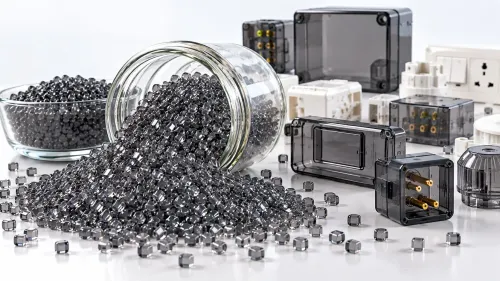
Approve blue ABS through a moulded plaque or production part, not by inspecting pellets. “Blue” and “royal blue” are incomplete specifications. Record a Pantone or RAL reference, masterbatch reference, approved plaque, L-star, a-star and b-star target, allowable Delta E, viewing illuminant, surface texture and gloss requirement.
Pellets can look uniform in a bag while the part changes shade or finish. Pigment loading, dispersion, barrel temperature, cooling, weld lines and mould surface all affect the result. Compare the supplier sample with a plaque or trial part made in the production mould, then inspect high-gloss and textured areas under the agreed lighting.
| Material route | Advantage | Main colour risk |
|---|---|---|
| Pre-coloured ABS compound | Better repeatability between lots | Less flexibility for last-minute shade changes |
| Natural ABS plus plant-added masterbatch | Flexible dosing and colour changes | Feeder errors create shade and dispersion variation |
Colourants can alter UV stability, gloss, melt viscosity, weld-line appearance and impact performance. Approve the colour with mechanical and processing specimens from the same blue grade, not with a colour plaque alone.
For incoming consumer goods granules, retain a sealed reference sample and release each lot only after checking pellet contamination, moisture, a moulded colour plaque and MFR. If the part is safety- or durability-critical, add notched Izod impact testing.
Set the process before judging the material
Start with the process, not the colour: the supplier’s datasheet must name the intended process and grade. Pellets sold as ABS dana are not interchangeable, because injection, extrusion and blow-moulding grades have different flow and melt-strength requirements.
For injection moulding, use a barrel range around 220–260°C only as a starting reference. Confirm the exact melt temperature, mould temperature, packing pressure and cooling time through a trial on the production machine and mould.
A high-flow grade can fill thin ribs and long flow lengths, but higher MFR does not prove higher toughness or weld-line strength.
Dry blue ABS granules after humid warehouse exposure using the grade supplier’s stated temperature and time. Inadequate drying causes splay, silver streaks, bubbles, dull gloss and lower impact strength; a universal shop-floor drying rule is unreliable.
For ABS shells, gate location controls filling and weld lines, while packing pressure affects sink and dimensions. Mould temperature also changes gloss, shrinkage and warpage.
Extrusion and blow moulding require a different assessment. Melt strength, die behaviour and parison control matter more than an injection-flow number, especially when a hollow part must hold its shape.
- Dry the lot, then record the machine, mould, colour formulation and settings.
- Produce trial parts from the actual equipment.
- Check fill, sink, warpage, gloss, weld lines and impact performance.
- Approve the consumer goods granules only after the trial parts meet the product specification.
Build a Delhi procurement check before placing the order
A seller calling itself a blue ABS granules manufacturer in Delhi may be a compounder, reprocessor, importer, distributor or repacker. Ask which operation it performs before treating the label “manufacturer” as evidence of polymerisation or colour-compounding capability.
| Role | What the seller does | What you must verify |
|---|---|---|
| Polymeriser | Makes ABS resin from monomers | Manufacturing site, grade and batch records |
| Compounder | Blends resin, additives and blue pigment | Formulation control, colour reference and data sheet |
| Reprocessor | Reclaims sorted ABS feedstock | Recycled percentage, heat history, ash and impact data |
| Importer or distributor | Resells another producer’s material | Original producer, sealed packaging and traceability |
| Repacker | Transfers pellets into new bags | Original lot number and certificate continuity |
Request a certificate of analysis listing the production batch, manufacturing location, grade, test methods, MFR temperature and load, notched Izod impact result, density, moisture, ash or filler level and colour reference. Confirm bag identification, virgin or recycled percentage, intended process, recommended drying conditions, processing window and the replacement policy for shade or property drift.
Use this purchase checklist:
- For every lot, compare moisture, MFR and a moulded colour plaque; inspect pellets for contamination.
- For a safety-critical part, retain a sealed lot sample and repeat notched Izod impact testing.
- Treat “ABS dana in Delhi” as a local sales description, not a grade specification.
- Contact PLASTO INDIA AND POLYMERS as one Delhi NCR source, then approve only after checking the exact grade, data sheet, certificate and production trial.
Related product
 | ₹95 all colors ABS granules AVAILABLE CONTACT No. 9278699961 View product → |
Frequently asked questions
Why is ABS used for everyday consumer products?
ABS combines rigidity, impact toughness, chemical resistance, flow and a mouldable surface finish, making it suitable for visible consumer parts.
How do you choose a blue ABS grade for a part?
Match the grade to impact strength, flow length, wall thickness, heat exposure, surface finish and regulatory needs rather than selecting by colour.
How should you approve the colour of blue ABS?
Inspect moulded parts and plaques under controlled lighting, then compare colour, gloss, weld lines, flow marks and batch consistency.
What should Delhi manufacturers check before ordering ABS dana?
Request the grade datasheet, batch number, technical values, colour reference, packaging details, quantity, delivery schedule and replacement terms.
Keywords