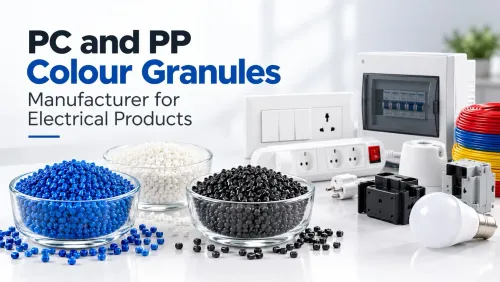
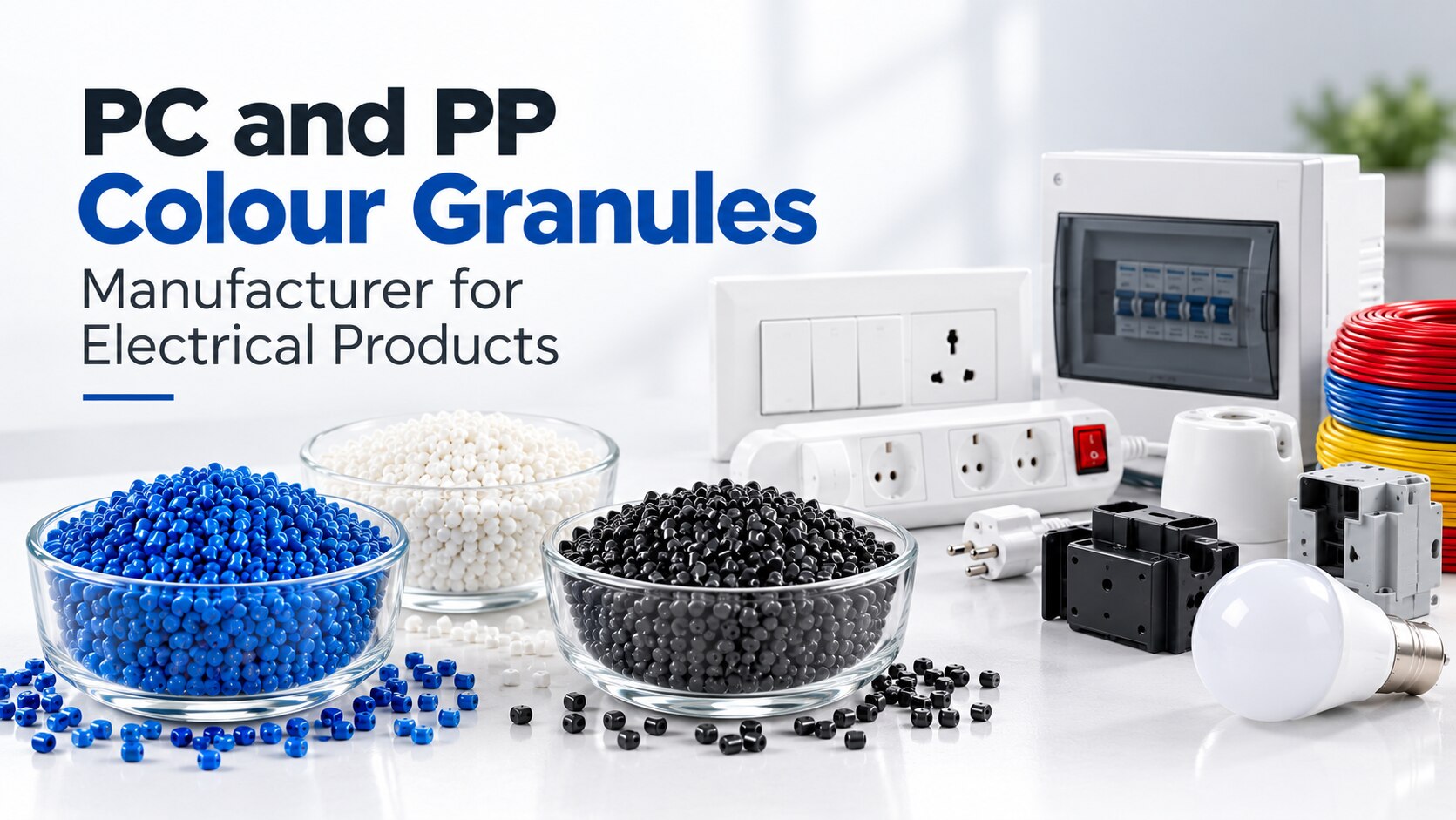
Choosing a colour is only the first step when plastic granules will become a switch housing, connector body or junction box. You will be able to compare PC and PP by performance, specify the electrical and colour evidence you need, and screen a Delhi supplier before approving a production batch.
Key takeaways
- Choose PC for impact and heat; choose PP for low weight, chemical resistance and flexing.
- Request the grade datasheet, batch certificate, UL details and IEC test evidence.
- Approve colour with moulded plaques while checking impact, insulation and heat performance.
- Control drying, melt temperature, moisture and shrinkage to prevent moulding defects.
PC or PP: which granule fits the electrical part?
PC suits parts that need high impact resistance, stiffness, heat performance and electrical insulation, but its higher density and weaker chemical resistance can limit use. PP is lighter, more chemically resistant and better under repeated flexing, but it has higher moulding shrinkage, lower stiffness and weaker heat performance.
| Material | Best fit | When it becomes the wrong choice |
|---|---|---|
| PC | Impact-critical switch housings, plug and connector bodies, junction boxes and appliance components | Thin walls, aggressive chemical contact, uncontrolled outdoor exposure or tight snap-fit tolerances without shrinkage validation |
| PP | Cable glands, coil bobbins, terminal components and chemically exposed or repeatedly flexed parts | High-temperature parts, impact-critical housings, precision snap-fits and fire-risk applications without specified flame retardancy |
| SAN | Natural san granules provide rigidity, dimensional stability and transparency | Not an interchangeable replacement for impact-critical PC housings |
| PP grades | Homopolymer gives stiffness; copolymer improves impact performance; choose virgin resin for controlled safety performance | Reprocessed resin needs verified contamination, shrinkage and electrical data |
| Special grades | Injection-moulding or extrusion grade, impact-modified, glass-filled, UV-stabilised or flame-retardant formulations | Never substitute grades by colour alone |
PC is not automatically a flame-retardant electrical grade. Ordinary PP is combustible; fire-risk parts need a specified flame-retardant formulation tested in the actual colour and wall thickness.
A pc and pp colour granules manufacturer should match the resin to heat, chemicals and flexing, then validate warpage, weld lines and snap-fit retention because PC and PP shrink differently.
Which grade and electrical test evidence should you request?
Put the exact polymer grade into the quotation request, not merely “PC electrical grade” or “PP colour granules.” Specify virgin or reprocessed resin, PP homopolymer or copolymer, injection-moulding or extrusion grade, melt-flow rate, density, filler percentage, impact data and the complete additive package, including flame retardant, UV stabiliser and reinforcement.
Request these electrical results for the exact formulation:
| Test or evidence | What to confirm |
|---|---|
| Volume resistivity | Insulation against leakage current |
| Dielectric strength | Voltage withstand in the specified thickness |
| Insulation resistance | Resistance of the finished part or material |
| Comparative tracking index | Resistance to surface tracking under moisture and contamination |
| UL 94 | Required result: V-0, V-1 or HB at the specified wall thickness |
| Glow-wire test | Temperature, time and pass result for the applicable product standard |
| Finished-part standard | Applicable IEC document or customer test specification |
UL 94 is thickness-dependent and applies to the tested formulation, colour and batch. A V-0 result at 1.5 mm does not prove V-0 at 0.8 mm. Confirm the finished part’s voltage, operating temperature, wall thickness, creepage distance, moisture exposure and fire risk before accepting the resin.
Colour, “electrical grade” and RoHS compliance do not establish electrical safety. Ask the pc granules supplier for a batch-level certificate of analysis, test reports, lot traceability and additive declaration. A catalogue description is not equivalent evidence.
How do you approve colour without weakening performance?
1. Approve colour on a moulded plaque or production-part sample, not loose pellets. Set a RAL or Pantone code, then record the approved sample, visual or spectrophotometer method, D65 lighting condition, observer angle and agreed colour tolerance, preferably a defined Delta E limit.
2. Specify the masterbatch carrier, pigment or additive system, recommended let-down ratio and validated processing-temperature range for the exact PC or PP grade. For pp colour granules in delhi, distinguish compounded coloured resin from a separate masterbatch mixed at the moulding plant; their dispersion and performance evidence are not interchangeable.
3. Do not add a PP-carrier masterbatch to PC when it causes poor dispersion, weld-line weakness, surface defects, high-temperature degradation or altered flame performance. Reject an unsuitable universal carrier for the same reasons.
Check whether pigment, carbon black, titanium dioxide, UV stabiliser or flame-retardant additives change heat absorption, UV stability, tracking, dielectric behaviour or flame performance.
4. Recheck every lot against the approved sample and specification. Colour, additive concentration and reprocessed content can shift shrinkage, flammability and electrical results, so repeat relevant moulded-part and electrical checks after a formulation or supplier change. For outdoor NCR use, specify UV-ageing exposure and colour-retention limits separately from the delivery colour match.
What processing controls prevent defects in PC and PP moulding?
Consistent electrical parts start with moisture control, clean equipment and a validated process window—not colour approval alone.
| Material | Starting control window | Main risk |
|---|---|---|
| PC | Supplier-validated drying near 120°C for several hours, sealed hopper storage, controlled moisture and melt around 280–320°C | Insufficient drying causes splay, silver streaks, bubbles, molecular-weight loss and reduced impact |
| PP | Drying is less demanding; prevent condensation, wet contamination and damaged packaging, then validate grade-specific melt and mould settings | Moisture and contamination cause streaks and unstable processing |
Use a controlled hopper for PC and confirm every temperature against the exact grade, colour formulation and machine. A mould temperature around 80–120°C suits many PC grades and geometries, but validate it. Limit residence time: overheated PC degrades, while copying PC temperatures onto PP can create its own defects.
Check melt temperature at the machine setup, not only from the material datasheet. Purge between colours and polymer families, clean the screw and hot runner, and control back pressure and screw speed.
- Black specks: inspect contamination, degraded polymer, screw deposits and hot-runner residue.
- Streaks or splay: check drying, hopper sealing, moisture and colour dispersion.
- Weld-line colour difference: review flow direction, gate location and pigment dispersion.
- Warpage: check shrinkage, cooling balance and fibre orientation.
A PP-to-PC change needs tooling and process validation. Different shrinkage and thermal behaviour can alter wall dimensions, snap-fit retention, weld-line strength, warpage and screw-boss performance.
How should you evaluate a Delhi supplier before placing the order?
A pc and pp colour granules manufacturer electrical in delhi must be compared with the supply chain behind the pellets, not the seller’s colour catalogue.
| Supplier type | What to verify | Main risk |
|---|---|---|
| Compound manufacturer | Exact grade, formulation, batch certificate and retained sample | Colour or additive changes between lots |
| Distributor or trader | Original producer, sealed packaging, lot traceability and repacking history | Unknown storage or substituted material |
| Masterbatch supplier | Carrier, pigment, let-down ratio and compatibility with PC or PP | Poor dispersion or altered flame performance |
Ask for the original producer, exact grade, colour code, batch number, manufacturing date, certificate of analysis, recommended drying conditions and additive declarations. Require batch evidence for melt flow, moisture, density, ash or filler content, contamination and colour difference.
For safety-critical parts, add UL 94, glow-wire and CTI reports; RoHS paperwork does not replace those tests or finished-part testing.
Confirm virgin or reprocessed content and ask whether the supplier will retain a reference sample from every lot. “Black electrical dana” and “available in all colours” are commercial descriptions, not specifications.
PLASTO INDIA AND POLYMERS is worth assessing only when its PC and PP colour granules come with grade-specific documents, approved samples, sealed packaging and clear conformity responsibility.
Use this order checklist:
- Part drawing, polymer, MFR, colour standard, carrier, additives, electrical tests, processing window, quantity and acceptance tolerance.
Frequently asked questions
Should you choose PC or PP for an electrical part?
Choose PC when the part needs high impact resistance, stiffness, heat performance and electrical insulation. Choose PP when low weight, chemical resistance and repeated flexing matter more.
Which documents and electrical tests should you request from a granule supplier?
Request the technical datasheet, batch or certificate of analysis, processing guidance, colour reference, and electrical evidence such as dielectric strength, volume resistivity, comparative tracking index and UL 94 flammability classification where applicable.
How can you approve colour without weakening performance?
Mould colour plaques or trial parts at the intended processing conditions, then compare shade, gloss and dispersion alongside impact, insulation, heat and dimensional results.
What should you check before ordering from a Delhi supplier?
Check material traceability, consistent batch samples, packing and storage, minimum order terms, delivery capability, technical support and the supplier's ability to provide documents for each batch.
Keywords