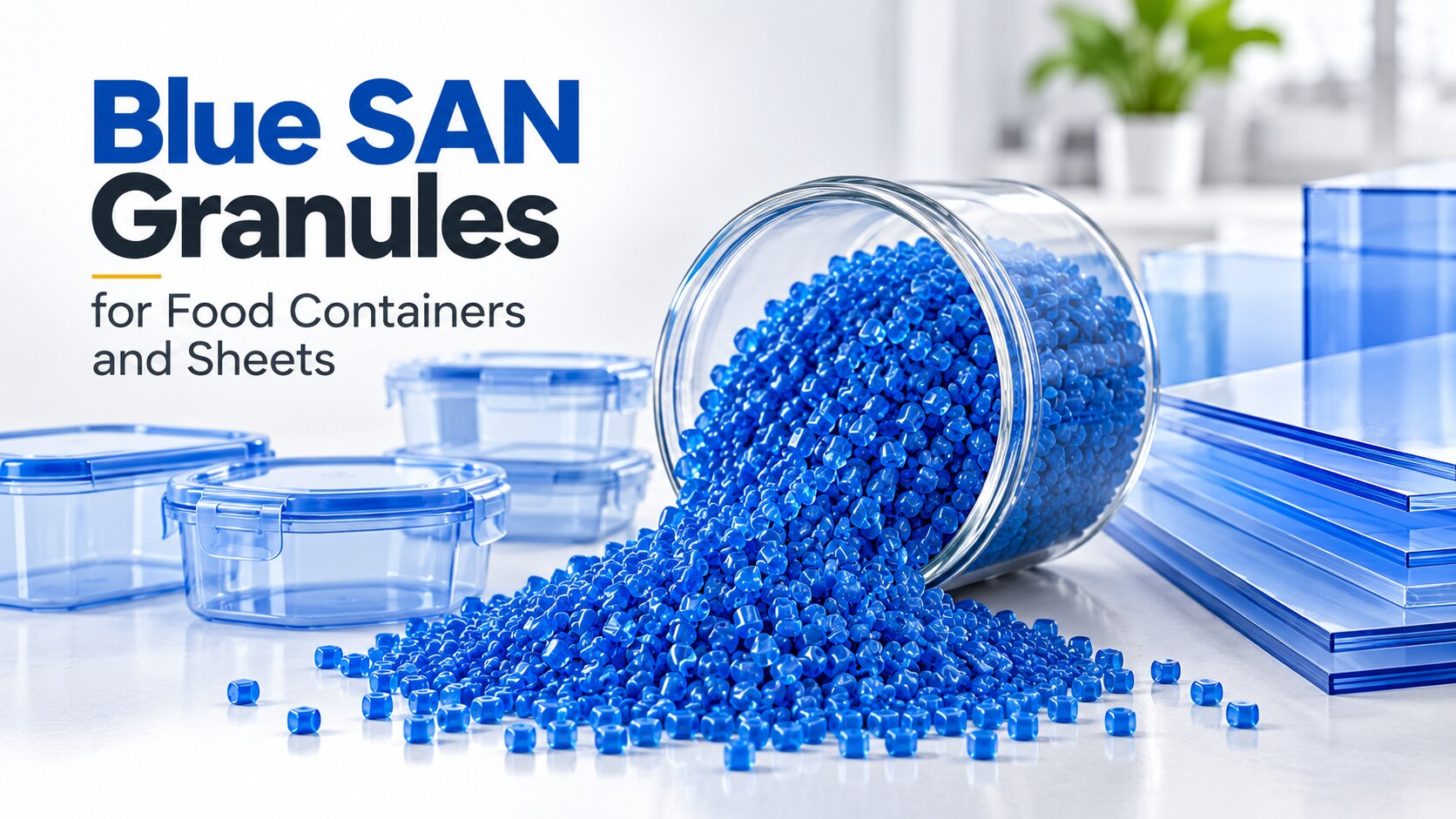
Colour alone does not tell you whether a blue SAN pellet is suitable for a food container or sheet. By checking the resin identity, colourant package, food-contact evidence, processing route and finished-part requirements, you can separate a suitable grade from a blue material that only looks right in a sample.
Key takeaways
- Colour alone does not identify a food-contact SAN grade.
- Ask for resin formulation, migration-test reports and food-contact declarations.
- Check melt flow, moisture, colour consistency and contamination before processing.
- Compare SAN with GPPS, ABS and HIPS against the container’s actual use.
What exactly are blue SAN granules?
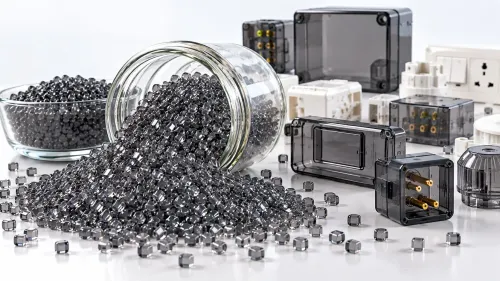
Blue SAN granules are not a complete, standardised resin grade identified by colour alone. SAN is a styrene-acrylonitrile copolymer, and the blue material may be virgin resin compounded with pigment, a pre-coloured compound, or natural SAN blended with blue masterbatch. These options can process and perform differently.
Request a written specification covering:
- Base-resin grade and styrene/acrylonitrile composition
- Virgin or reprocessed status and post-consumer recycled content
- Melt-flow rate, density and impact strength
- Heat-deflection temperature and processing-temperature range
- Pigment, carrier resin and additive declaration
- Batch number, batch owner and lot traceability
A Delhi seller calling itself a manufacturer may be a base-resin producer, local compounder or distributor. Check the documents for the actual manufacturing site, batch owner and country of resin production; a Delhi address does not prove that the seller made the polymer.
Reprocessed content is not equivalent to virgin resin without evidence. It can change odour, colour consistency, molecular weight, impact performance and migration behaviour. For food containers or sheets, ask for a lot-specific certificate of analysis and confirm that the blue formulation—not only uncoloured SAN—matches your required application.
A similar melt-flow value does not prove equivalent food-contact performance.
What evidence proves suitability for direct food contact?
A blue SAN pellet cannot be called food-safe from the uncoloured resin’s approval alone. Require a signed food-contact declaration covering the complete formulation: SAN, blue pigment, carrier resin, dispersant, stabilizer and processing aids.
Ask for evidence matched to the finished use:
- An IS 9845 migration report using conditions that match the food, temperature, contact duration, and single-use or repeated-use service.
- Pigment and colourant evaluation against IS 9833, including pigment migration evidence.
- A lot-specific certificate of analysis with batch number, test results and manufacturing traceability.
- A declaration stating that the evidence applies to the finished container or sheet, not only to food container granules or plastic dana.
- Results for odour, colour bleeding and visible or measurable pigment transfer.
The finished article is the practical compliance object. Wall thickness, blue pigment loading, surface-area-to-food ratio, moulding or sheet-extrusion history and contact time can change migration results even when the pellets match their certificate.
Require written answers for acidic foods, oily foods, hot-fill, refrigeration, freezer storage, microwave heating and sterilisation. A generic “food grade” statement proves none of these uses. If the supplier cannot identify the tested article, maximum temperature, contact period and intended reuse status, do not treat the blue SAN as suitable for direct food contact.
How should blue SAN be processed into containers and sheets?
One blue SAN grade should not serve every process: use injection moulding for rigid containers, and extrusion or sheet extrusion for flat stock that may later be thermoformed. The amorphous resin avoids crystallisation controls, but temperature, shear and residence time still control appearance and cracking.
1. For injection moulding, ask for drying instructions, the maximum time pellets may remain in sealed packaging, barrel temperature range, screw speed, residence-time limit, mould-temperature range and recommended container wall thickness. Humid pellets can produce splay, bubbles and surface defects, even though SAN is less moisture-sensitive than nylon or PET.
2. Keep heat, shear and residence time within the supplier’s limits. Excessive processing can cause yellowing, colour streaks, silver streaks and residual-stress cracking. A moulding grade that fills a small container cleanly is not automatically suitable for sheet extrusion.
3. For sheet, specify thickness tolerance, width, flatness, surface finish, haze or transparency, colour tolerance, melt strength and thermoforming behaviour. Confirm that the sheet will draw without whitening, cracking or excessive thinning.
Approve blue against a physical standard or CIELAB values measured under a named illuminant and observer. Shop-floor lighting, pigment concentration, mould temperature and sheet thickness can shift the apparent colour. When buying plastic granules in Delhi, obtain a trial sheet or moulded article before approving production.
How does blue SAN compare with GPPS, ABS and HIPS?
SAN is the best choice only when rigidity, appearance and moderate chemical resistance matter more than impact strength, cost or heat resistance. Blue SAN granules suit rigid, display-oriented containers, lids, trays and sheets exposed to oils or mild chemicals—not every food-contact application.
| Material | Stiffness and clarity | Chemical or impact performance | Cost and processing |
|---|---|---|---|
| SAN | More rigid and generally clearer than GPPS; suitable for visible parts and flat sheets | Stronger chemical resistance than GPPS, but lower impact resistance than ABS | Usually more costly and less simple than GPPS |
| GPPS | Clear and rigid, but less robust chemically | Low impact resistance | Simpler, lower-cost option when SAN’s advantages are unnecessary |
| ABS | Less transparent than SAN and generally less rigid | Higher impact resistance; choose it when drops matter more than transparency | Processing depends on grade and additives |
| HIPS | Less clear than SAN and GPPS | Better impact performance than GPPS, while sacrificing clarity | Practical for toughness where a translucent or opaque appearance is acceptable |
Choose an alternative by the failure you need to prevent. Use an impact-focused styrenic grade for repeated drops or severe flexing; review a higher-temperature engineering polymer for high-temperature sterilisation.
If the application involves food, require the manufacturer or a documented food-contact compounder to assess the complete blue formulation, because colour alone proves neither suitability nor compliance. A blue grade without supporting food-contact documentation is a poor choice, regardless of its clarity or stiffness.
How can a Delhi buyer qualify a supplier and incoming batch?
Before ordering plastic granules in Delhi, write a purchase specification that describes the finished article, not just “blue SAN.” State the food type, maximum contact temperature, contact duration, article thickness, injection or sheet-extrusion process, transparency or opacity, drop-resistance target, sterilisation exposure, colour tolerance and finished container or sheet dimensions.
- Request the base-resin grade, actual manufacturer, country of resin production and batch owner.
- Request a technical data sheet, safety data sheet, certificate of analysis, food-contact declaration, IS 9845 migration report and IS 9833 colourant evidence.
- Request drying and processing guidance covering sealed-packaging limits, temperature range and residence time.
- Require the batch number, lot traceability, sealed-packaging details and an agreed retained sample.
Compare the certificate with independent incoming checks. Melt-flow rate screens processing consistency; it does not prove food safety, because two batches with similar flow can differ in pigment compliance or migration.
| Supplier certificate | Independent check | Why it matters |
|---|---|---|
| Melt-flow rate | Re-test melt flow | Flags processing variation |
| Density | Measure density | Detects grade or formulation changes |
| Moisture | Karl Fischer or moisture analyser | Finds splay, bubbles and surface defects |
| Colour | Compare CIELAB values under a named illuminant | Controls shade drift |
| Ash or inorganic loading | Ash test | Reveals filler or pigment variation |
Ask whether PLASTO INDIA AND POLYMERS owns the batch or trades it; a Delhi address alone does not prove it is the manufacturer. Approve the supplier only after it identifies the manufacturing site, supplies lot-specific documents and matches the material to your process.
Frequently asked questions
What exactly are blue SAN granules?
Blue SAN granules are styrene-acrylonitrile copolymer pellets coloured with pigment or blue masterbatch. Colour alone does not identify the resin grade, additives or food-contact status.
What evidence proves blue SAN is suitable for direct food contact?
Request the exact grade name, formulation or additive disclosure, food-contact declaration, applicable test reports and migration results for the intended food, temperature and contact time.
How should blue SAN be processed into containers and sheets?
Confirm the supplier’s drying instructions, melt-flow range, recommended barrel temperatures, mould or die settings and residence-time limits. Control moisture, contamination and colour carryover during production.
How does blue SAN compare with GPPS, ABS and HIPS?
SAN offers clarity and chemical resistance; GPPS offers clarity but is more brittle; ABS provides toughness but is usually opaque; HIPS improves impact resistance through rubber modification but sacrifices clarity.
How can a Delhi buyer qualify a supplier and incoming batch?
Verify the manufacturer’s technical data sheet, certificate of analysis, batch number, seal and traceability. Test colour, melt flow, moisture, contamination and basic mechanical performance before release.
Keywords